Katz’s Delicatessen on Manhattan’s Lower East Side is an American culinary landmark — famous for towering pastrami sandwiches, noisy counters, and a line that looks eternal. But for Muslim visitors and readers the practical question is simple and urgent: is Katz’s halal? This post unpacks that question from every useful angle: what Katz’s actually is, how its meats are prepared, the technical differences between kosher and halal slaughter, ingredient-level red flags, what Muslim scholars say, and practical guidance so you can decide with confidence.
Quick answer
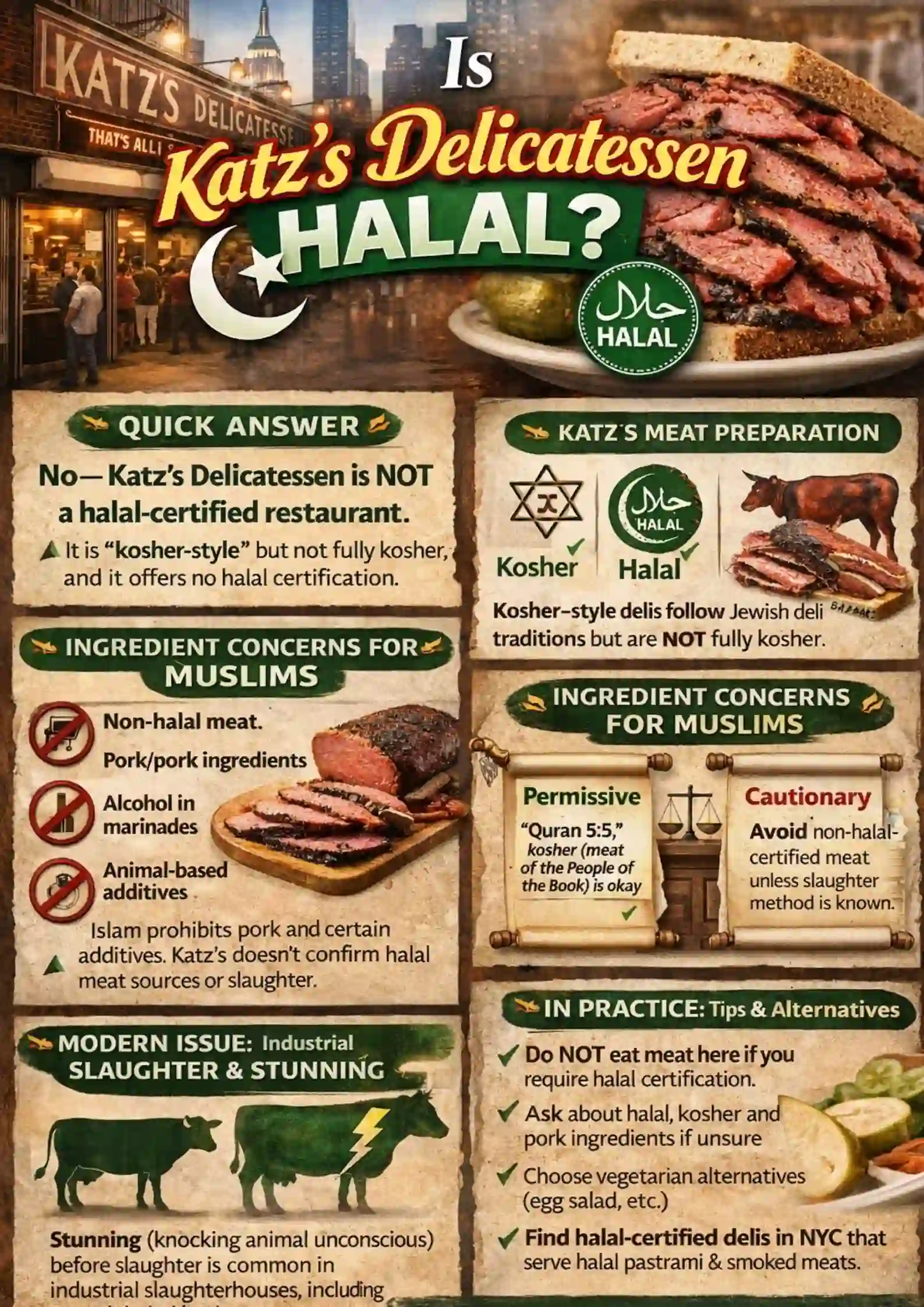
No — Katz’s Delicatessen is not a halal-certified restaurant. It is widely described as “kosher-style” but not kosher, and it offers no public halal certification. That means if you require halal certification or strict halal slaughter standards, Katz’s is not a reliable option.
What Katz’s Delicatessen actually is
Katz’s is a century-old New York institution (est. 1888) famous for pastrami, corned beef, brisket and classic deli sandwiches. The menu and identity are rooted in Jewish deli tradition — rye bread, mustard, pickles and spice-rubbed smoked beef — but the business itself does not operate under a kosher certificate. It describes itself as a landmark deli with nationwide shipping and a classic deli menu. That “kosher-style” label describes cuisine lineage, not religious compliance.
Why kosher automatically halal?
Many people conflate “kosher” and “halal” (they share similarities), and sometimes assume kosher meat is automatically halal. Important clarifications:
- “Kosher-style” means food made in the cultural tradition of Jewish delis — but may be prepared without rabbinical supervision or adherence to kashrut. Katz’s is kosher-style, not kosher-certified.
- Kosher (shechita) and halal (dhabīḥah) are both ritual-slaughter traditions with overlapping aims (rapid, controlled blood drainage and prohibition on pork), but they have distinct religious rules and supervisory systems. In practice there are technical differences in procedures, supervision and how modern stunning is handled. These technical differences matter to jurists deciding permissibility.
How Katz’s meats are prepared
Typical deli mainstays at Katz’s include pastrami, corned beef, brisket, roast beef and smoked tongue. At a process level:
- Corned beef — brisket brined in salt, spices and often sodium nitrite (a curing agent), then simmered or roasted.
- Pastrami — brisket or navel brisket cured (similar to corned beef), rubbed with a spice crust (pepper, coriander, garlic), then smoked.
- Brisket/roast — often brined, sometimes smoked, sometimes roasted.
- Sandwich components — rye bread, mustard, pickles, sometimes Swiss cheese (e.g., Reuben contains dairy).
Important implications: curing and smoking are post-slaughter processes and do not make a non-halal-slaughtered animal halal. Process chemicals (nitrates, phosphates) are generally neutral from a halal perspective unless they contain forbidden animal derivatives or alcohol-based flavorings — uncommon but possible in some industrial preparations.
Ingredient-level red flags Muslims should watch for
When you assess a deli like Katz’s for halal suitability, check these specifics:
- Source of the meat / slaughter method — the primary issue. Was the animal slaughtered according to an acceptable halal method? Katz’s does not publish halal sourcing info.
- Presence of pork or pork-derived ingredients — Katz’s menu is centered on beef and poultry; mainstream Katz’s menu items do not include pork cuts, but cross-use and supply-chain issues must be checked case-by-case.
- Alcohol in marinades or sauces — some dressings or marinades may contain alcohol-derived extracts; always ask about dressings (e.g., some “Russian” dressings or pickling liquids can contain wine or vinegar derived from wine processes).
- Hidden animal-derived additives — certain flavor enhancers, gelatins or emulsifiers can be animal-derived (rare in a deli sandwich but possible in processed condiments).
- Cross-contamination — shared slicers, knives, counters or fryers can lead to mixing with non-halal items (if any non-halal is present in the kitchen).
Because Katz’s is not halal-certified, these uncertainties remain open for any given visit.
What Muslim scholars and fatwas say — two main positions
When it comes to eating kosher or non-certified meats, Islamic jurists typically fall into two pragmatic camps. I summarize the main views and cite representative rulings.
Position A — Permissive
Many scholars say that the meat of the People of the Book (Jews and Christians) is permissible by default — based on Qur’anic wording that describes food of the People of the Book as lawful (Qur’an 5:5). Contemporary fatwas often add conditions: the animal must actually have been slaughtered (not dead before slaughter) and slaughter should follow a cutting of the throat with blood evacuated. Several established online fatwa outlets state that meat bearing kosher certification is generally permissible unless there is specific evidence of impermissible ingredients (e.g., alcohol added).
Position B — Cautionary / restrictive
Other scholars and juristic bodies advise caution in modern contexts: they warn that industrial processes, pre-stunning practices, or lack of reliable verification make it unsafe to assume meat is halal. Some jurists (and institutions in certain countries) recommend avoiding non–halal-certified meat unless its method of slaughter and supply-chain integrity can be confirmed. For example, Darul Uloom Deoband has advised caution about trusting meat labeling in many contexts and sometimes recommends avoiding uncertain meats altogether.
Practical takeaway from scholars
There is no single unanimous global ruling that automatically makes all kosher-style deli meat halal. The permissibility often depends on (a) certainty about the slaughtering method, (b) absence of forbidden additives, and (c) one’s jurisprudential approach or personal caution level.
The modern sticking point: stunning, industrial slaughter and verification
A major contemporary issue is pre-slaughter stunning — many modern slaughterhouses stun animals for welfare and regulatory reasons, then perform ritual cutting; the acceptability of stunned-and-then-slaughtered meat varies among Muslim jurists and halal certifiers. Jewish shechita historically requires the animal to be conscious (stunning is usually not permitted in orthodox shechita), while many halal certifiers also prohibit pre-stunning. Because commercial kosher and halal practices in large supply chains may differ, the mere fact that meat is “kosher” does not automatically resolve the halal-stunning question for all Muslims. Scholarly guidance often recommends verifying the exact practices of the supplier if this issue is important to you.
Practical checklist — deciding whether to eat at Katz’s
If you’re a Muslim trying to decide in practice, here’s a short, actionable checklist:
- Do you require halal certification? If yes — do not eat meat at Katz’s. No halal certificate is published.
- Are you comfortable with kosher / People-of-the-Book permissibility and occasional uncertainty? Some Muslims accept kosher-slaughtered meat as permissible for reasons summarized above — if so, you might accept Katz’s meats if you can verify the supplier’s kosher status (but Katz’s itself is not kosher-certified).
- Prefer to avoid ambiguity? Choose vegetarian sandwiches, salads, or coordinate ahead for specifics about ingredients and dressings (many deli sides are vegetarian or dairy).
- Ask staff directly (very specific questions): “Is this meat halal-certified?” “Who supplies the pastrami?” “Do you use any pork products in the kitchen?” Real-world answers vary by location and over time; Katz’s official stance is that it’s not kosher/halal-certified.
Alternatives & halal-friendly delis in NYC
If you want the Katz’s pastrami experience but with halal assurance, look for halal-certified Middle Eastern or Jewish-style delis and halal butchers in NYC that explicitly state halal sourcing (Muslim-owned delis, halal charcuterie shops, or restaurants serving halal smoked beef). Many halal-certified spots produce smoked and cured beef using halal-slaughtered sources. When in doubt, search for halal certification logos or contact the restaurant directly.
Conclusion
Katz’s Delicatessen is an iconic New York deli offering classic pastrami and corned beef in a “kosher-style” tradition — but it is not halal-certified and is widely reported as not being kosher-certified either. For Muslims requiring strict halal-compliant slaughter and certification, Katz’s is not a suitable choice. For Muslims who accept kosher (or People-of-the-Book slaughter) and are comfortable with some uncertainty, opinions vary among jurists — some permit such meats while others advise caution because of modern industrial practices (stunning, supply-chain opacity). The responsible approach is to identify your own legal/ethical standards, ask specific ingredient and sourcing questions when possible, and otherwise choose vegetarian or certified-halal alternatives.
Key sources used for this post: Katz’s official site and historical descriptions (Katz’s Delicatessen), reporting that Katz’s is “kosher-style” but not kosher, and Islamic rulings discussing the permissibility of eating the food of the People of the Book and modern cautions about trusting unverified meat sources.