The world of bubble tea arrives like a small weather system: sugar-sweet gusts, chewy storms of pearls, the muted thunder of a straw tapping a plastic lid. For many Muslim consumers this delightful climate brings a question that must be settled with care: is Gong Cha — the global bubble-tea brand with thousands of outlets — halal to drink? The short answer is: sometimes — and the reason why is a story about ingredients, franchises, certificates, and nuance.
Below I’ll walk you through everything you need to know: how halal status is determined, what in Gong Cha’s recipes can raise questions, where Gong Cha is certified, how to verify a shop near you, and practical steps to order safely. This is a researched, source-backed look written in an accessible, slightly literary style so you get both clarity and a little pleasure while you read.
The simple, honest headline: Halal status depends on place & certificate
Gong Cha is an international franchise; its halal status is not uniform across all countries or even all outlets in the same country. Some national branches or individual outlets hold halal certificates from recognized bodies; others do not. That means you cannot assume “Gong Cha = halal” everywhere — you must check locally.
Why it varies: the franchise, the supply chain, the certificates
Franchises like Gong Cha license operations to local business entities. Ingredients, suppliers, and preparation methods are often chosen locally. A syrup, topping, or creamer that’s halal-certified in one country might be different in another. Because halal certification is issued to the operator (or to the specific product/supplier), a brand can be halal in Country A while remaining uncertified in Country B. For official verification in Malaysia, for example, you can consult the government halal portal (JAKIM); Malaysian Gong Cha outlets have been publicly listed as certified in certain locations.
What’s inside your cup — ingredients that usually are halal
At its core, most Gong Cha drinks are made from tea, water, sugar, milk or creamer, fruit syrups or purees, and tapioca pearls. Many of these base components — black or green tea, sugar, plain tapioca pearls (made from cassava starch) — are intrinsically halal when not contaminated by haram additives. Commercial tapioca pearls are generally starch-based and therefore acceptable in principle.
The possible troublemakers: gelatin, hidden animal derivatives, and alcohol in flavourings
There are three common sources of halal concern in bubble tea:
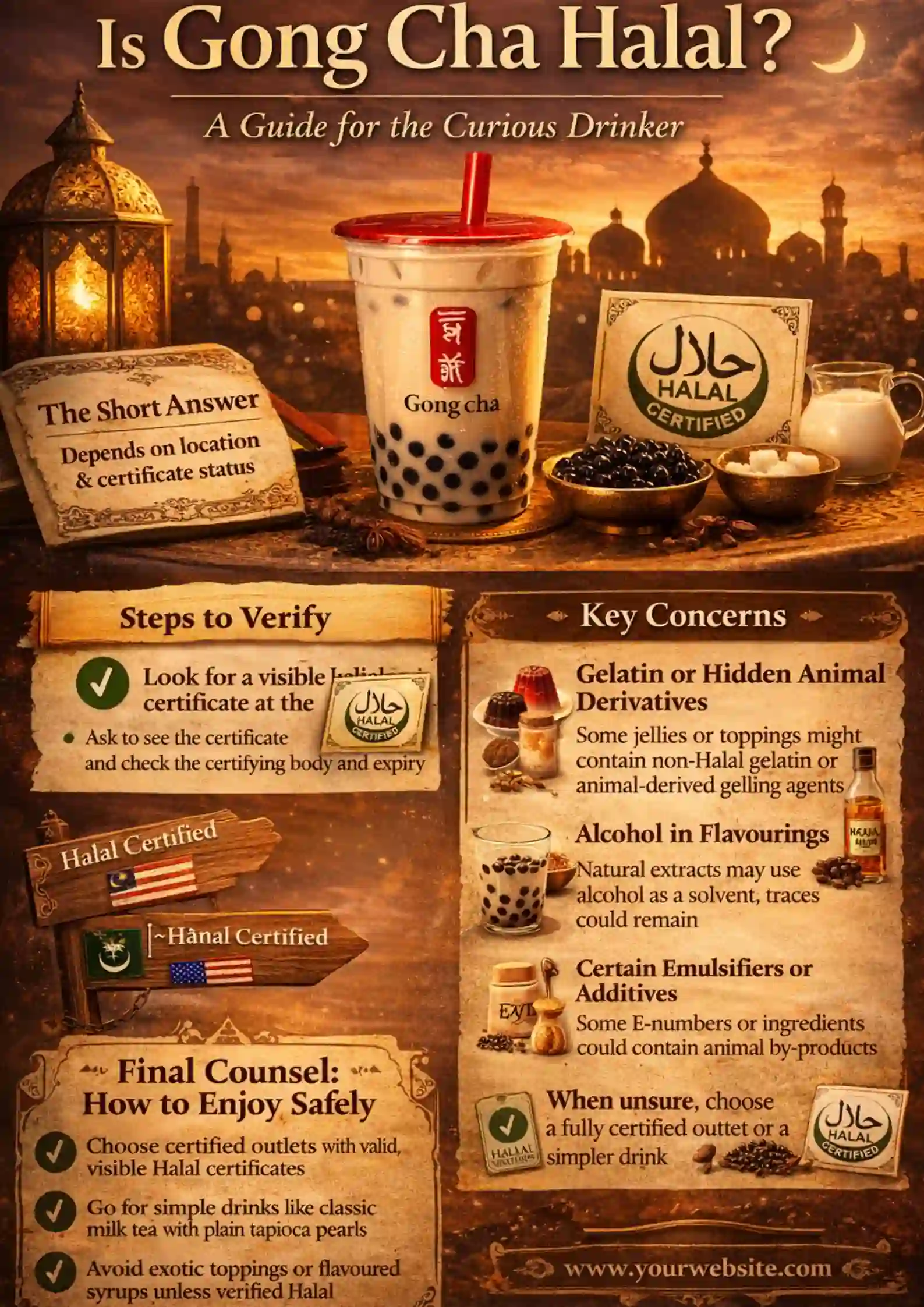
- Gelatin or animal-derived gelling agents: Some jellies or pudding toppings can use gelatin derived from non-halal animals. Not all toppings contain gelatin, but flavored jellies and certain puddings sometimes do.
- Hidden animal-derived emulsifiers or additives: Ingredients like certain E-numbers, emulsifiers or co-products may be derived from animal sources unless the manufacturer states otherwise.
- Alcohol as a solvent in natural flavour extracts: Many natural flavour extracts (e.g., vanilla, some fruit essences) are produced using ethanol as an extraction solvent; traces may remain in the finished flavouring. Some halal authorities treat such flavourings as problematic unless they are specifically alcohol-free or the finished product is halal-certified. This is a general, well-documented concern across the food industry.
Because of these possibilities, a single ingredient (a berry syrup, a “natural flavour” label, a jelly mix) can change the ruling from permissible to questionable — depending on its provenance.
What Gong Cha’s own ingredient lists tell us
Brand ingredient lists published by national Gong Cha sites and ingredient PDFs show staples like tea powders, non-dairy creamer (often containing milk derivatives), sugar, and various powdered mixes and jellies. These lists are helpful because they show presence of items such as sodium caseinate (a milk protein from cows) and carrageenan — not haram, but useful to know for allergen/ingredient transparency. The specifics vary by country site; always check the local Gong Cha outlet’s ingredient information.
Concrete examples: where Gong Cha is certified
In some countries and specific outlets, Gong Cha has pursued and obtained halal certification. For instance, certain Gong Cha outlets in Malaysia are reported to be certified by JAKIM (Malaysia’s halal authority), and the company has publicized halal certified branches. In Australia, some Gong Cha menu items are explicitly marked “halal-certified” or “gelatin-free” on localized sites. These certifications reflect local audits of suppliers, processes, and controls. If a branch displays a valid halal certificate from a recognized body (e.g., JAKIM, MUIS, MUI, HFA), that outlet’s certified items are considered halal under that authority’s rules.
How to verify — a short, practical checklist before you sip
If you want to be certain before ordering, do this:
- Look for a visible halal certificate at the outlet — ask to see it and note the certifying body and expiry. (If the shop claims to be halal but has no certificate, ask which body issued it.)
- Ask about specific toppings — avoid jellies or puddings unless the staff confirm they are gelatin-free and halal-certified.
- Prefer plain tapioca pearls and basic milk-tea variants — classic milk teas with plain pearls are less likely to contain problematic additives than limited-edition flavored jellies or “popping” pearls. (Tapioca pearls are typically cassava starch.)
- Check local Gong Cha web pages or ingredient PDFs for your country; many national pages list ingredient facts or allergen info.
- When in doubt — choose halal-certified outlets or brands. If no certification exists, ask for supplier details or opt for a simpler drink.
Common scenarios and ruling-style guidance
- Certified outlet with active certificate: You may consume certified items per that body’s scope. If the certificate covers the outlet and its menu, the ruling follows the issuing authority.
- Uncertified outlet but ingredients appear halal: This is a gray area. Many consumers will accept a plain milk tea with plain tapioca pearls after verifying no gelatin or alcohol-containing flavourings are used; others prefer formal certification. The cautious approach is to ask for supplier documentation or choose a certified alternative.
- Flavored pearls, “popping” pearls, or certain jellies: Investigate the ingredient/supplier — these items can contain non-halal ingredients or alcohol-based flavourings. Better to avoid unless certified.
A few examples of good practice from other Muslim consumers & authorities
Community halal trackers and Q&A platforms often list which outlets are certified, and local halal authorities maintain searchable registers (for example, Malaysia’s government halal portal lists certified premises). Many Muslim consumers also rely on national halal associations’ guidance about flavour extracts and processing methods — particularly on whether trace alcohol in a flavouring renders the item impermissible under their school’s understanding. Checking both the outlet certificate and the local halal authority’s database gives the strongest reassurance.
Final counsel — how to drink Gong Cha with confidence (or graceful abstention)
If you love Gong Cha and live where branches carry a credible halal certificate (or where the national Gong Cha web pages explicitly mark items halal), drink with joy. and If you’re in an area where Gong Cha has not pursued halal certification, you still have sensible options: choose simple classics (plain milk tea, plain pearls), avoid exotic toppings, and ask staff about gelatin or special flavourings. If absolute certainty is your priority, prefer outlets with a valid certificate issued by a recognized halal authority.
Remember: halal is not only about ingredients but about supply chains and hygiene practices. Certifying bodies look at both what goes into the cup and how it is prepared. That is why a certificate matters — it is a tested promise, not merely a label.
Closing — A small reflection
The bubble tea cup is a little transparent globe: on one hand, delight; on the other, questions that ask for care and mindfulness. When you choose halal, you are asking for both: the sweetness of the drink and the integrity of its making. Gong Cha can meet that ask in many places — but the map is not uniform. Let curiosity be your compass, certificates your guide, and simple ingredients your peace.
Sources & further reading
- Gong Cha (national ingredient pages and corporate ingredient PDF).
- Public announcements and listings of halal-certified Gong Cha outlets (Malaysia social posts; community trackers).
- Gong Cha Australia menu notes (halal-certified / gelatin-free items marked on menu).
- Why flavourings can contain alcohol and the halal implications of extracts (food guide / halal advisory sources).
- Tapioca pearls — composition and typical ingredients (cassava starch).