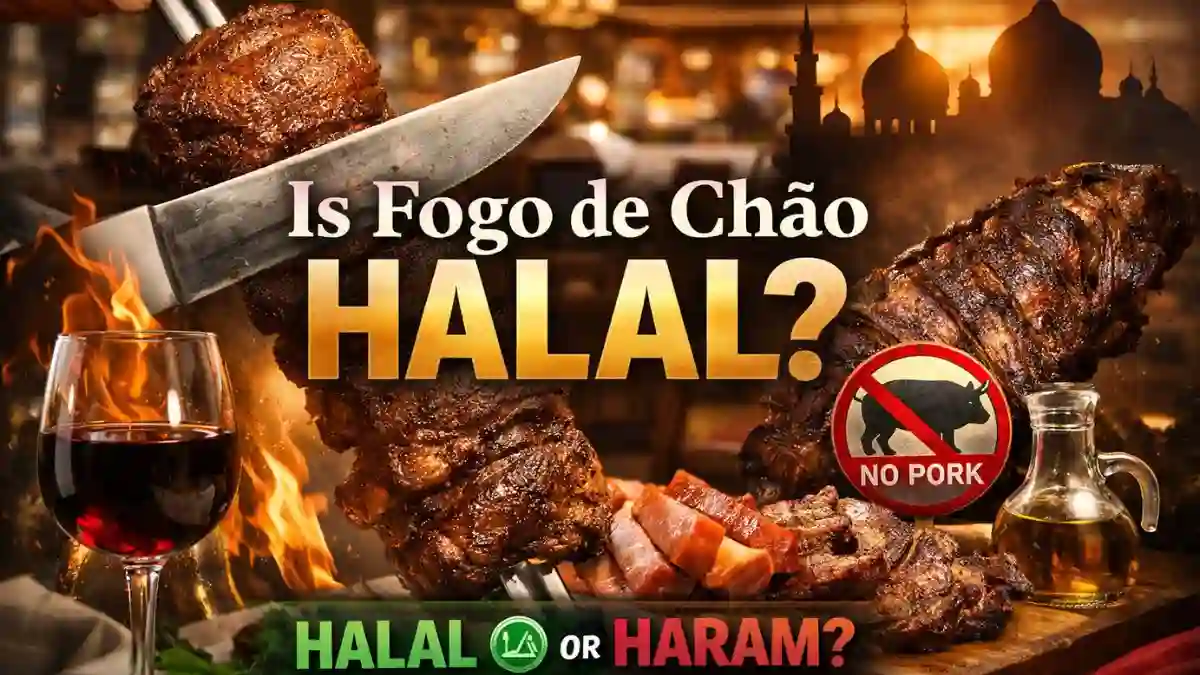
The first thing you notice at Fogo de Chão is not the meat. It’s the atmosphere. Low golden lights. Polished wood. White tablecloths. Gauchos gliding through the room with long skewers of fire-roasted beef, carving slices directly onto your plate. It feels theatrical, luxurious, almost sacred — a ritual built around meat.
And that’s where the question quietly enters a Muslim diner’s heart:
“Can I eat here… with peace?”
Fogo de Chão is not just another steakhouse. It is a global symbol of Brazilian churrasco, celebrated for its abundance and quality. But for Muslims, quality alone is never enough. The real standard is halal — lawful, ethical, spiritually clean.
So let’s slow down. Let’s remove assumptions. And let’s answer the question properly.
Is fogo de chao Halal?
This guide is not rushed.
It is not emotional.
And it is not judgmental.
It is careful — the way halal questions deserve to be.
Short Answer
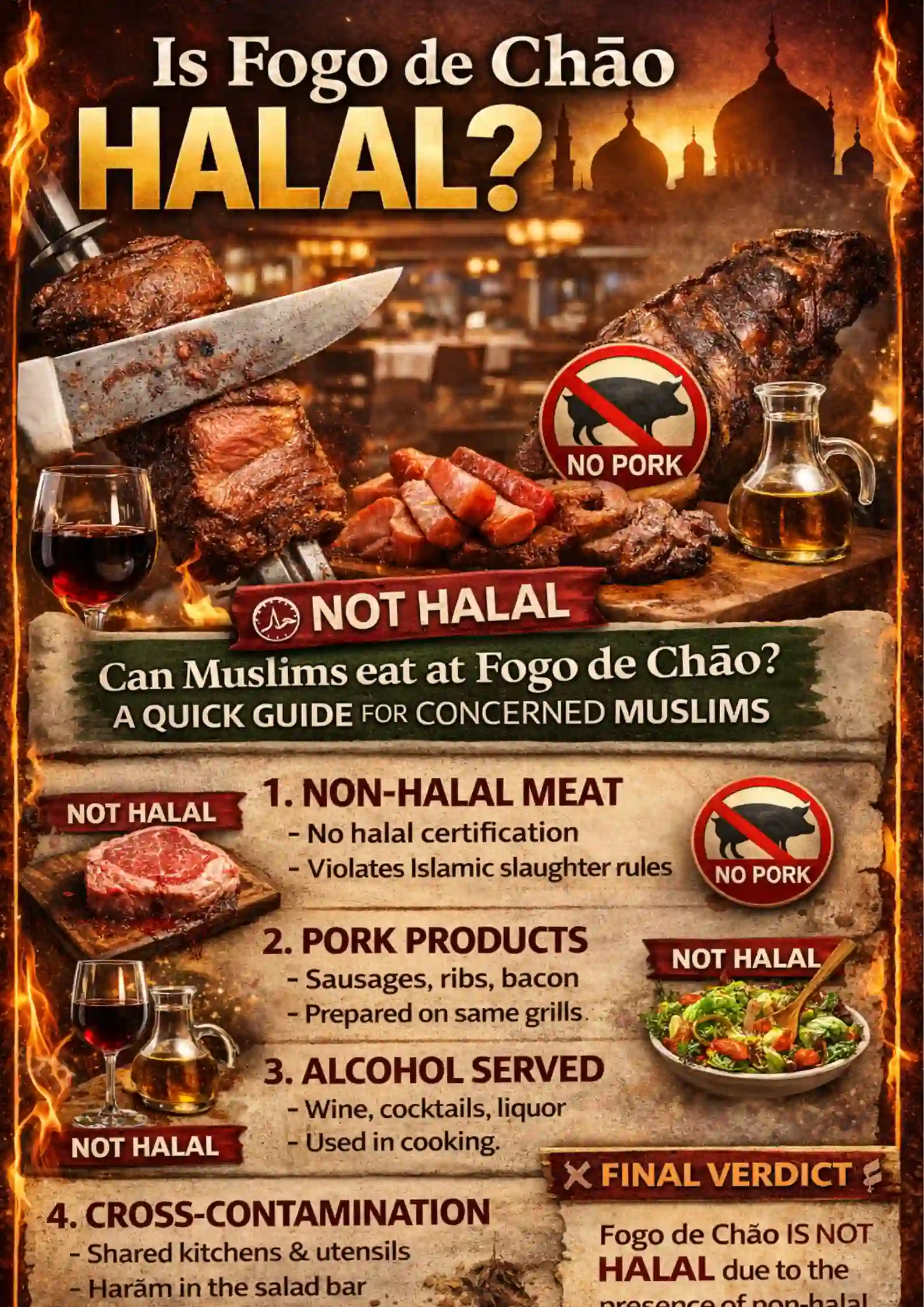
No. Fogo de Chão is not halal. Fogo de Chão does not use halal-certified meat, does not follow Islamic slaughter requirements, and serves pork and alcohol openly in its kitchens and dining rooms.
That means Muslims should not eat the meat at Fogo de Chão. The longer explanation — the one that matters — begins below.
What Exactly Is Fogo de Chão?
Before ruling anything halal or haram, we must understand what it is. Fogo de Chão is a Brazilian churrascaria, founded in Porto Alegre, Brazil, and now operating across:
- The United States
- Brazil
- The UK
- The Middle East
- Asia
Its identity is built on:
- Large-scale meat service
- Continuous carving of grilled beef, lamb, chicken, pork
- An all-you-can-eat experience
- A premium wine and alcohol program
This matters, because halal is not only about ingredients — it is about systems.
The Halal Standard (Very Briefly)
For meat to be halal, all of the following must be true:
- The animal must be halal (beef, lamb, chicken — acceptable)
- The animal must be slaughtered according to Islamic law
- The name of Allah must be mentioned at slaughter
- Blood must be properly drained
- No contamination with haram substances
- No cross-contamination with pork or alcohol
Failing any one of these conditions makes the meat haram.
Ingredient & Menu Analysis | What’s Actually Being Served?
Let’s break it down honestly.
1. Beef, Lamb, Chicken (The Core Offering)
Yes — these animals are permissible in theory.
But here’s the issue:
- Fogo de Chão sources meat from conventional commercial suppliers
- There is no halal certification
- There is no Islamic slaughter process
- No invocation of Allah at slaughter
That alone is decisive.
Permissible animal + non-Islamic slaughter = NOT halal
2. Pork (A Major Red Flag)
Fogo de Chão serves multiple pork items, including:
- Pork ribs
- Sausages
- Bacon-wrapped cuts
In Islamic law, pork is haram by essence — not just by method.
Even more critically:
- Pork is cooked on the same grills
- Carved with shared knives
- Prepared in shared kitchens
This creates direct cross-contamination.
3. Alcohol (Another Structural Problem)
Alcohol is not a side detail at Fogo de Chão. It is central.
- Wine pairings
- Caipirinhas
- Bar service at every location
- Alcohol used in sauces and marinades
According to the majority of scholars:
- Serving alcohol
- Cooking with alcohol
- Using shared surfaces without cleansing
All violate halal integrity.
4. The Salad Bar & “Safe” Items — Are They Really Safe?
Many Muslims ask:
“Can I just eat the salad bar?”
Technically, vegetables are halal.
But practically:
- Same serving area
- Same utensils
- Same kitchen
- Same contamination risk
Most scholars advise avoiding food from kitchens where haram is dominant, unless strict separation exists — which Fogo de Chão does not provide.
Official Statements & Certifications
Here is what matters most:
- Fogo de Chão does NOT claim halal status
- No halal certification is displayed
- No halal suppliers are mentioned
- No Islamic compliance statement exists
In halal matters, silence means no.
If a restaurant were halal, it would proudly say so.
Scholarly Opinion
Across major Islamic schools of thought — Hanafi, Maliki, Shafi‘i, Hanbali — the ruling is consistent.
Key Principles Applied:
- Meat slaughtered without dhabiha is haram
- Certainty is not removed by doubt
- Avoiding haram is obligatory even when tempting
Relevant Scholarly Sources (Widely Accepted):
- Dar al-Ifta (Egypt)
- IslamQA
- European Council for Fatwa and Research
- AAOIFI Shariah Standards
All conclude:
“Meat from non-Muslim commercial slaughterhouses is not halal unless verified otherwise.”
Therefore:
Eating meat at Fogo de Chão is not permissible for Muslims.
Common Arguments
But it’s just beef, not pork
Halal is about how, not just what.
Beef slaughtered without Islamic method is haram.
What if I say Bismillah before eating?
Saying Bismillah does not change the slaughter method.
Intention does not override law.
What about necessity?
This is not a necessity. No hunger, danger, or survival situation exists.
But it’s expensive and high-quality!
Islam never links halal to price.
Something can be luxurious — and still forbidden.
Emotional Reality | Why This Question Hurts
Let’s be honest.
Places like Fogo de Chão represent success, celebration, and belonging.
Choosing not to eat there can feel like:
- Missing out
- Being “difficult”
- Feeling isolated
But halal is not about deprivation.
It is about dignity.
Every time a Muslim chooses faith over appetite, something stronger than taste is nourished.
Halal Alternatives
You don’t have to give up great meat — only questionable meat.
1. Halal-Certified Steakhouses (Location-Dependent)
- Muslim-owned steak restaurants
- Halal butcher-to-table concepts
- Certified suppliers with visible credentials
2. Middle Eastern & Turkish Grills
- Lamb chops
- Beef kebabs
- Charcoal-grilled meats
- Clear halal sourcing
3. Brazilian-Style Halal Concepts (Emerging)
Some cities now offer:
- Halal churrasco
- All-you-can-eat halal grills
- Muslim-owned Brazilian kitchens
The experience can exist — without compromise.
The Final Verdict
Let’s state it clearly, without drama:
Fogo de Chão is not halal.
- The meat is not slaughtered Islamically
- Pork is widely used
- Alcohol is integral
- No halal certification exists
- Cross-contamination is unavoidable
For Muslims who care about halal integrity, eating there is not permissible. Walking away is not weakness. It is worship.
Can Muslims Eat at Fogo de Chão?
This question deserves more than a quick yes or no. For many Muslims, dining choices are not merely about taste or price — they are deeply connected to faith, conscience, and obedience to divine guidance. Fogo de Chão, with its global reputation for premium meats and refined dining, naturally invites curiosity from Muslim diners. The restaurant looks sophisticated, the meat appears clean and high-quality, and nothing about the surface experience immediately signals “haram.” That is precisely why assumptions can be dangerous.
A proper halal investigation requires stepping beyond appearances. It asks uncomfortable but necessary questions: How is the meat sourced? Who slaughters the animals? Is Islamic law followed at any stage of the process? Are pork and alcohol present in the same environment? This title reflects a careful, methodical approach — one that refuses to declare something halal or haram based on emotion, marketing, or convenience. Instead, it commits to evidence, transparency, and Islamic principles.
By framing the issue as an “investigation without assumptions,” the focus remains respectful and fair. It does not accuse, exaggerate, or sensationalize. It simply follows the halal criteria step by step and allows the conclusion to emerge naturally. For Muslim readers who value sincerity over shortcuts, this approach builds trust and credibility from the very first line.
Fogo de Chão and Halal Dining । Where Luxury Meets Islamic Limits
Fogo de Chão represents luxury dining at its finest — elegant interiors, attentive service, and an endless parade of expertly grilled meats. For many, eating there symbolizes celebration, success, and indulgence. But Islam teaches that not every form of luxury is automatically permissible. Some pleasures, no matter how refined, must stop where divine limits begin. This title captures that delicate tension.
Halal dining is not opposed to quality or enjoyment. Islam does not demand blandness or deprivation. However, it does establish clear boundaries: lawful animals, proper slaughter, cleanliness, and avoidance of pork and alcohol. When a restaurant’s core identity conflicts with these principles, luxury alone cannot justify participation. This is where “Islamic limits” come into play — not as restrictions meant to punish, but as moral guardrails designed to protect faith and integrity.
This title invites readers to reflect, not just to judge. It acknowledges the appeal of Fogo de Chão while honestly examining whether that appeal can coexist with halal requirements. The result is a thoughtful discussion about priorities: when elegance and excess meet faith and restraint, which one should a Muslim choose? The answer, though challenging, becomes clearer through informed reflection.
Behind the Skewers । Why Fogo de Chão Fails the Halal Test
At Fogo de Chão, the skewers are the stars of the show — long, gleaming rods of fire-roasted meat carved tableside with theatrical precision. To many diners, they represent craftsmanship and abundance. But for Muslims, what lies behind those skewers matters far more than how impressive they look. This title promises to go beyond the spectacle and examine the unseen realities.
Failing the halal test does not mean the food is low quality or poorly prepared. It means that the essential Islamic requirements are not met. The slaughter method is not Islamic, halal certification is absent, pork is prepared openly, alcohol is central to the dining experience, and cross-contamination is unavoidable. When these factors are considered together, the conclusion is not emotional or hostile — it is simply factual.
This title is bold, but not reckless. It signals a clear outcome while still grounding that outcome in religious standards rather than personal opinion. By taking readers “behind the skewers,” it removes the distraction of presentation and focuses on process, sourcing, and compliance. For Muslim readers seeking clarity rather than comfort, this honest framing provides exactly what they need: truth without theatrics.
A Quiet Closing Thought
Halal is not a label. It is a trust. And sometimes, the most faithful decision is the one no one applauds — except Allah.