Instant noodles are a pantry staple around the world — cheap, fast, and comfortingly familiar. But for Muslims who follow halal dietary rules, one question keeps coming up: Is Top Ramen halal? The short answer is: It depends — on the country, the flavour, and whether the specific pack carries a recognised halal certification. Below I’ll walk you through everything you need to know, why the answer varies, how to check a pack yourself, and halal alternatives when you want a guaranteed option.
Why there’s no single yes or no?
Top Ramen is a brand owned by Nissin Foods, and Nissin’s product range, recipes, and certifications vary by market (USA, Europe, Indonesia, Malaysia, India, etc.). In some markets some Nissin/Top Ramen products are halal-certified; in other regions the company states its products are not halal. Because recipes, suppliers, and manufacturing lines differ by country, a blanket global answer is impossible. Always check the packaging and local manufacturer statements. (nissin-foods.eu)
What Nissin / Top Ramen says
In some regional company pages (e.g., Nissin’s European FAQ), the company explicitly states that their products are not halal — an important signal for customers in Europe where Nissin’s lines may not be halal-certified. At the same time, Nissin’s product pages in other markets list vegetarian flavours (e.g., Soy Sauce) and also show that some local Nissin products are marketed as halal-certified in countries such as Indonesia and Malaysia. This split between markets is the core reason for the “it depends” answer. (nissin-foods.eu)
Flavour matters: vegetarian flavours vs meat-flavoured seasoning
- Vegetarian flavours (e.g., Soy Sauce or Chili / some “stir-fry” packets) often have simpler ingredient lists — enriched flour, vegetable oil, salt, soy/powdered seasoning — and may be acceptable to many Muslims if there is no animal-derived ingredient or cross-contamination. Nissin itself labels some soy-sauce/chili Top Ramen as vegetarian on product pages. Still: “vegetarian” doesn’t always mean “halal-certified” (manufacturing environments and ambiguous ingredients like “natural flavors” or hydrolyzed protein remain concerns). (Nissin Food)
- Meat-flavoured packets (e.g., Beef, Chicken, Shrimp) commonly contain meat extracts, hydrolyzed animal proteins, or flavorings whose origin is not always disclosed on the pack. If those meat derivatives are not from halal-slaughtered animals (or are from prohibited sources), they would render the product non-halal. Even if the flavour says “beef” or “chicken,” it’s not safe to assume halal unless the pack carries a recognised halal logo.
- Seafood / shrimp flavours: Islamic scholarly opinions vary by school regarding shellfish — some consider all seafood halal; others restrict. Even when seafood itself is acceptable, the seasoning still needs scrutiny for non-halal additives.
Common ingredient red-flags to watch for
When judging a pack, look for these problem ingredients or terms that require closer checking:
- Gelatin (unless explicitly halal-certified and from halal source).
- Lard, tallow, or animal fat without source details.
- Natural or artificial “meat” flavors or hydrolyzed animal protein (HAP) — may be derived from non-halal animals.
- Beef/chicken extract without halal certification.
- Cross-contamination notices (e.g., “manufactured in a facility that also processes pork”) — some scholars consider cross-contamination acceptable at very low levels, others do not; many consumers prefer certified products to avoid doubt.
- Ambiguous “natural flavors” — manufacturers aren’t required to disclose source; if halalness matters, prefer certified lines.
Ingredient lists on official product pages or the back of the pack are your first line of defence. When a term is ambiguous, certification is the gold standard.
Look for local halal certification — the gold standard
Because local production and sourcing differ, the most reliable indicator is a halal logo issued by a recognised body in your country or region: e.g., JAKIM (Malaysia), MUI/LPPOM (Indonesia), BPJPH, JAKIM, or other national authorities; trusted private certifiers are sometimes accepted locally but always check recognition.
- In Indonesia and Malaysia, several Nissin products (including some Nissin ramen lines) have been issued halal certificates by local authorities (MUI/LPPOM) — this is verifiable through local Nissin news or the halal authority listings. If a Top Ramen pack carries the local halal logo, it is considered halal according to that authority’s inspection. (nissinfoods.co.id)
- In regions where Nissin states its products are not halal (for example on some European pages), the absence of a halal logo should be treated seriously. (nissin-foods.eu)
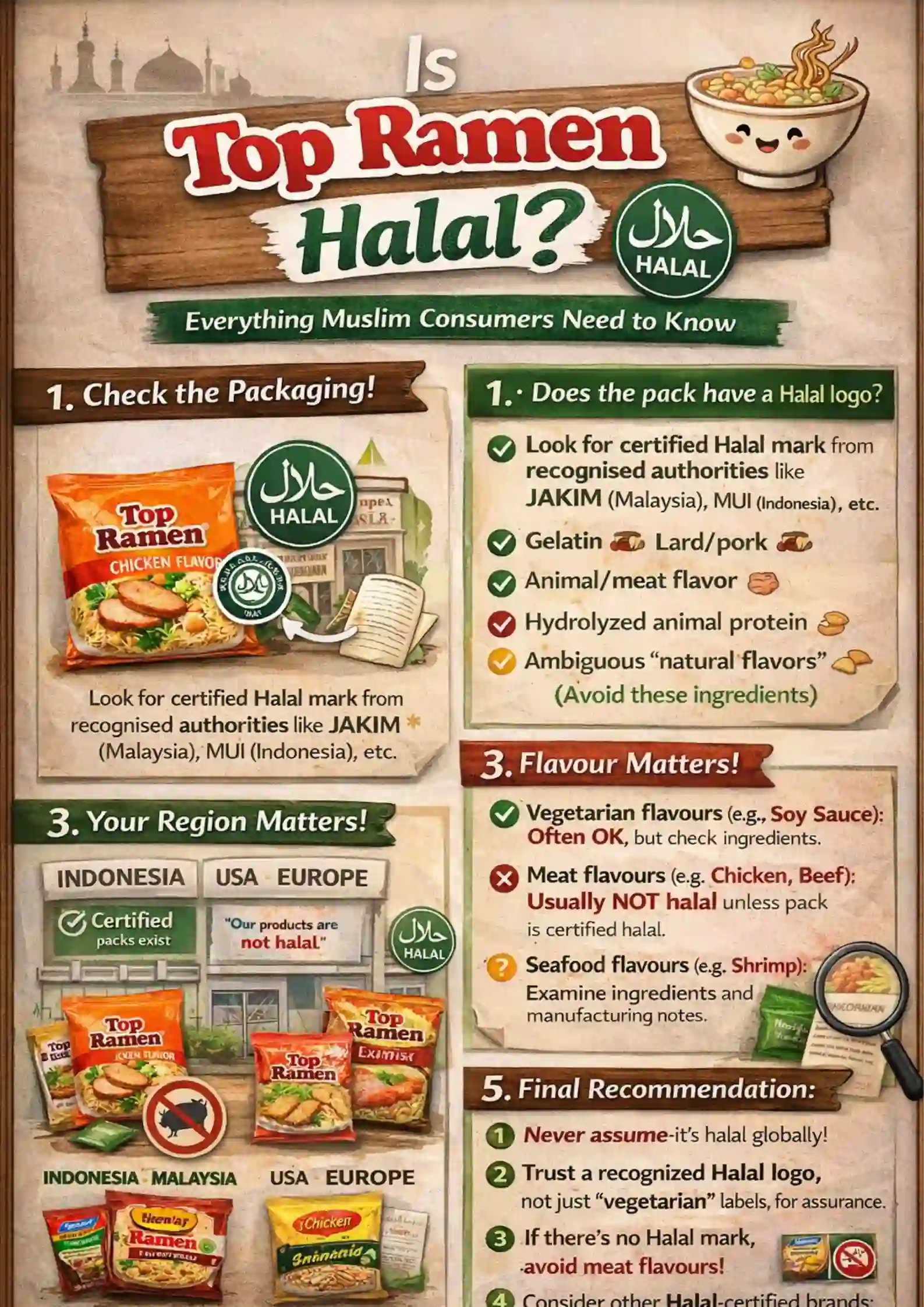
Practical steps: how to check a Top Ramen pack
- Read the packaging: Look directly for a halal logo and the certifying body’s name.
- Check the ingredients: Avoid packs with gelatin, lard, ambiguous “natural flavours,” or named animal extracts without halal notes.
- Check the “made in” / manufacturing facility note: If the product is made in a facility that processes pork, some consumers will avoid it.
- Search locally: Visit the local Nissin / Top Ramen website or the national halal authority’s database (if available) to confirm certification for that specific SKU.
- When in doubt — don’t assume: Vegetarian labels help but are not a substitute for halal certification if you want full assurance.
- Use community resources cautiously: Muslim consumer sites and forums can help (lists of halal products exist), but always cross-check with the official certifier or packaging. (Nissin Food)
Examples from different markets
- United States / North America: Top Ramen sold in the US has vegetarian flavours (e.g., Soy Sauce) that Nissin lists as vegetarian on product pages — these may be acceptable to many Muslims, but they are not universally labelled “halal” by Nissin USA. For meat-flavoured packets in the US, there is typically no halal claim, so check labels carefully. (Nissin Food)
- Europe: On Nissin’s European FAQ the company states its products are not halal; consumers in Europe should therefore check for local halal labelling or use certified alternatives. (nissin-foods.eu)
- Indonesia / Malaysia: Nissin has obtained halal certification for certain products (e.g., some “UFO” / local variants and specific ramen SKUs) via local halal authorities; such certified products are sold with official MUI/BPJPH logos. This shows that the same brand can be halal in one country but not in another. (nissinfoods.co.id)
- India / South Asia: There are product lists and local scanners that claim certain Top Ramen/Top Ramen India SKUs are halal, but the situation can vary by SKU and manufacturer batch — verify by checking the pack and local certifier lists. (Mustakshif halal scanner)
If you already own a pack and can’t verify
If you already have a pack and there’s no halal logo and the ingredient list looks ambiguous:
- If the flavour is clearly vegetarian (and the ingredient list confirms no animal derivatives), many scholars allow consumption.
- If the pack contains meat extracts or ambiguous ingredients, or the manufacturer says their products are not halal in your region, avoid it unless you can confirm halal certification.
- If your conscience requires certainty, throw it out or give it to someone for whom halal is not a concern — better to avoid doubt for peace of mind.
Halal alternatives
If you want instant noodles with clear halal assurance, consider:
- Look for local halal-certified SKUs from large manufacturers (e.g., Nissin’s halal-certified lines in Indonesia/Malaysia). (nissinfoods.co.id)
- Brands that explicitly advertise halal (in many markets there are halal-certified instant noodles such as Samyang halal-certified SKUs, local brands like Maggi in some countries, or plant-based instant noodles from companies that carry halal and kosher certifications). (Amazon)
- Independent halal-certified “ramen-style” brands exist (and are sold online) — check the certifier before you buy.
Final recommendation
- Never assume that Top Ramen is halal globally. The halal status depends on the market and the SKU.
- Trust a recognised halal logo over product descriptions like “vegetarian” alone when you need absolute certainty.
- If there is no halal mark and the ingredients are ambiguous, avoid the meat-flavoured packets. Use vegetarian-flavour packs only after checking ingredient lists.
- When in doubt, buy certified alternatives (either a halal-certified Nissin SKU in your region or another brand that clearly displays a local halal certificate).
Sources & further reading
- Nissin (Europe) FAQ — company statement that “Our products are not halal.” (nissin-foods.eu)
- Nissin Top Ramen product pages (example: Top Ramen Soy Sauce product page — labelled vegetarian). (Nissin Food)
- Nissin Indonesia / local news showing certain Nissin products (e.g., UFO ramen variants) are halal-certified by MUI/LPPOM. (nissinfoods.co.id)
- TheHalalLife (UK) compiled list of Nissin products with halal/haram status (useful aggregator — cross-check with pack/certifier). (The Halal Life)
- Local halal scanner / Mustakshif list for Top Ramen halal products in India — illustrates regional SKU differences. (Mustakshif halal scanner)
Short FAQ
Q: Can I eat Top Ramen Soy Sauce flavour?
A: Possibly — many soy-sauce Top Ramen packs are vegetarian and accepted by many Muslims, but you should still check ingredients and the absence of cross-contamination warnings. (Nissin Food)
Q: Is Top Ramen Beef halal?
A: Not necessarily. Beef-flavoured seasoning may contain non-halal extracts unless the pack specifically carries halal certification. Do not assume halal without verification.
Q: If the manufacturer’s website says “our products are not halal,” what should I do?
A: Avoid the product unless the specific SKU in your country is certified halal by a recognised local body. (nissin-foods.eu)