Short answer (if you want it up front): Kava is not automatically halal or haram by simple formula — its permissibility in Islamic law depends on two linked questions: (1) does the specific preparation produce an intoxicating effect that is legally equivalent to khamr (wine/ethanol), and (2) is it being used for a permissible purpose (social/customary vs. recreational intoxication vs. medicine)? Muslim jurists remain divided: some treat kava as prohibited because of its sedative, mind-altering effects and potential harms; others allow limited medicinal or socially-regulated use when it does not cause intoxication. Below you’ll find the cultural background, pharmacology, health concerns, and the major Islamic legal viewpoints so you can write or decide with clarity.
What is kava, really?
Kava — often called kava kava — is a traditional drink made from the root of the plant Piper methysticum, native to the Pacific Islands. The root is crushed or ground and mixed with water (or coconut milk) to produce a peppery, numbing beverage consumed in many Pacific cultures as part of rituals, ceremonies and social gatherings. Its active compounds, called kavalactones, produce relaxing, sedative and anxiolytic effects; they can also produce mouth-numbing sensations. These effects are unlike ethanol (alcohol) in some ways — kava tends to calm and relax rather than produce the particular disinhibiting euphoria of alcohol — but it is psychoactive and can impair coordination and cognition at higher doses.
Pharmacology and what the science says
Kava’s main active ingredients — the kavalactones — interact with brain receptors (including GABAergic systems) and can reduce anxiety and promote calm. Clinical studies have examined kava as a treatment for anxiety, with mixed but promising results in certain trials. However, concerns emerged in the early 2000s about rare but serious liver toxicity linked to some kava products, prompting regulatory warnings and restrictions in several countries; while many modern assessments view properly sourced, “noble” kava and moderate usage as lower risk, liver safety and product quality remain real issues. There is also evidence that heavy recreational consumption can cause skin changes (“kava dermopathy”), sedation, and interactions with medicines.
3. Why Muslims ask “is it halal?” — the legal hinge
In Islamic law, there is a central prohibition on khamr (traditionally wine/fermented intoxicants) because intoxicants that cloud the mind and impair judgement are clearly forbidden. Over time, jurists extended the prohibition principle to anything that intoxicates or causes similar social harm. So when a new or culturally specific beverage like kava appears, scholars ask: (a) does it intoxicate in the legally relevant sense? and (b) does it cause harm or lead to sinful behaviour? If the answer to (a) or (b) is “yes,” many jurists will rule it haram; if “no,” or if it is used strictly as medicine under necessity, the ruling can be permissive.
How Islamic scholars have ruled
There is no single global consensus. Scholarly positions fall roughly into three camps:
- Caution / Prohibition: Some scholars and fatwa bodies consider kava haram because it produces effects similar to drunkenness (slurred speech, impaired coordination) or because it is psychoactive and potentially harmful. Where it is used recreationally with impairment, these bodies equate it with intoxicants and forbid it. A historic fatwa thread on IslamWeb records concern and prohibition by some jurists for those reasons.
- Conditional permissibility (medical or limited social use): Other jurists allow kava if it does not intoxicate in the legal sense or when used strictly as medicine under necessity; some Hanafi-oriented responses note that if kava is only medicinal and limited to therapeutic doses, it may be permitted. SeekersGuidance and similar advisory centres provide nuanced answers permitting kava for stress relief when conditions of non-intoxication and medical need are met.
- Contextual / Cultural acceptance: In communities where kava is a long-standing cultural ritual (certain Fijian, Samoan, Vanuatu contexts), local Muslim practice may tolerate communal kava drinking as a customary social act when it is not understood as intoxicating to the point of moral harm. Some practitioners and community imams therefore treat kava differently than ethanol, emphasizing local norms and the actual observable effects.
Key fatwas and advisory opinions
- IslamWeb (earlier fatwa): Expressed strong reservations and labeled the plant by referencing UN drug classifications; concluded caution and potential prohibition in some contexts.
- IslamQA / AskImam (Hanafi-inclined answers): Provided conditional rulings — allowing medicinal use in dire necessity and indicating caution for recreational use. These answers emphasise the classical principle that a harmful or intoxicant substance is prohibited except in clear medical necessity.
- SeekersGuidance: Offered a balanced opinion that kava may be permissible for stress relief if it does not intoxicate and is used within medical norms, citing traditional jurisprudential sources on medicine and necessity.
Takeaway: different jurists weigh intoxication, harm, cultural context and medical need differently. If a reader wants a definitive ruling for their own practice, the best route is to consult a trusted local scholar with details about how the kava is prepared and used.
Comparing kava and alcohol: similar, different, important
- Similarity: Both can alter mood and behaviour; both can impair coordination and judgement at sufficient doses. This similarity is why many scholars treat kava with suspicion.
- Difference: Ethanol (wine, beer, spirits) directly matches the classical category of khamr in the Qur’an and hadith — the textual prohibition is explicit. Kava’s psychoactive profile is pharmacologically distinct: it is primarily a CNS depressant with anxiolytic properties rather than an ethanol-type intoxicant; many users report calmness rather than the disinhibition associated with alcohol. This pharmacological difference is why some jurists do not immediately equate kava with khamr.
Health and legal concerns you should not ignore
Beyond jurisprudence, two practical problems matter for ethical permissibility: harm and public health/regulation.
- Liver toxicity: Several reports and regulatory warnings (including actions in the 2000s) linked certain kava extracts to liver damage; while modern sourcing and avoiding problematic extracts reduce risk, the association remains in clinical literature. Users with liver disease, those on hepatically metabolised drugs, or those combining kava with alcohol/medications face clear danger.
- Product quality and adulteration: Some commercial products have been made from non-noble cultivars or extracts, or blended with other substances — this raises both medical risk and an Islamic legal problem (if a product contains alcohol or other haram additives). Always check product sourcing and lab testing.
- Social risk: Like alcohol, if kava use leads to neglect of duties, impaired worship, or social harm, that practical effect can make it impermissible in many juristic frameworks.
How to decide personally
If you plan to write or recommend a stance in a blog post, suggest the following decision steps for readers:
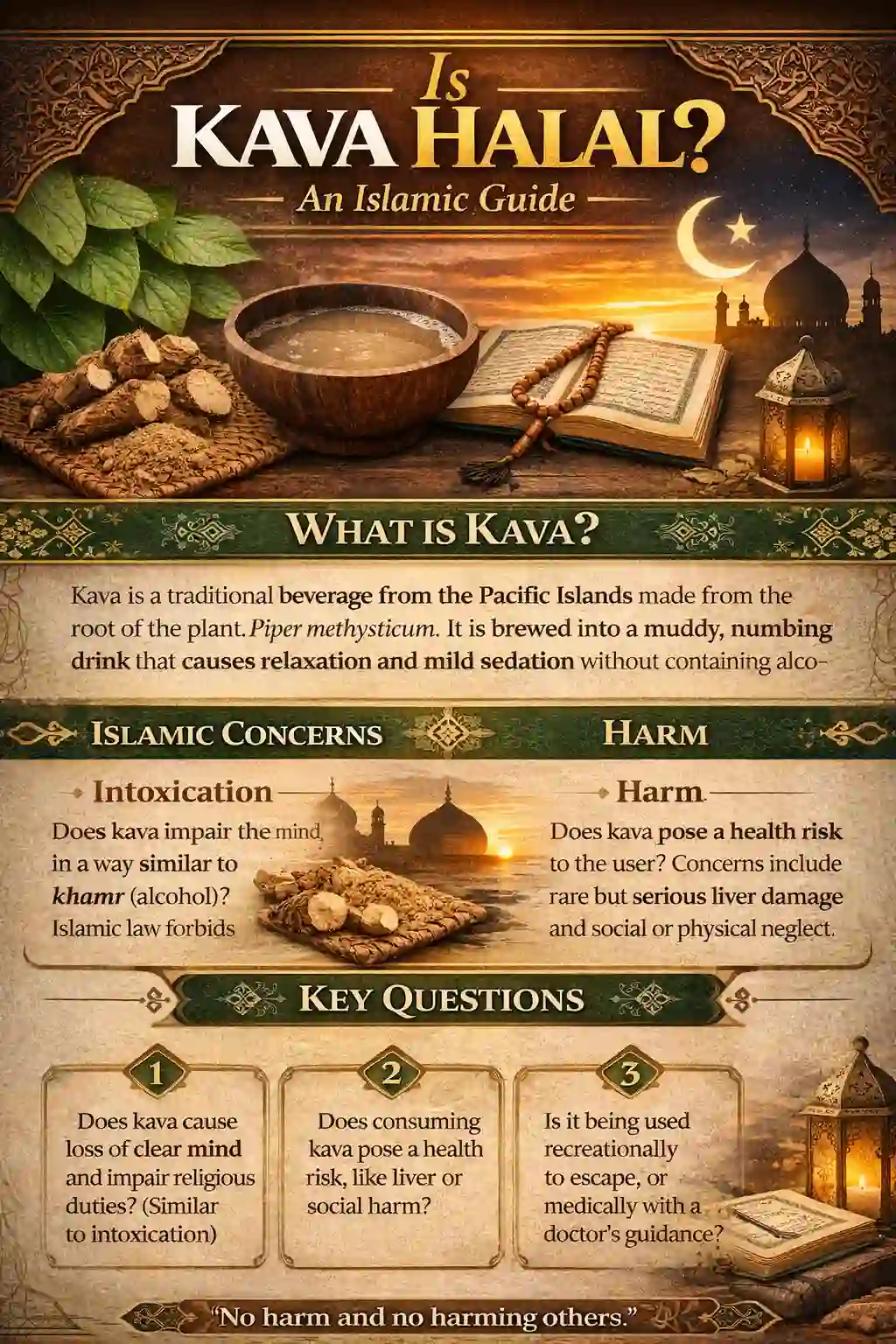
- Assess purpose: Is the kava being used as medicine (with a doctor’s advice), as a cultural ceremonial drink, or for recreational relaxation? Medical necessity changes the ruling for many jurists.
- Observe effect: Does the specific product cause intoxication (loss of clear mind, inability to perform religious duties)? If yes → strong presumption against permissibility.
- Check product content: Ensure there’s no alcohol, haram additives, or adulterants. Prefer “noble” kava cultivars and lab-tested suppliers.
- Consult local scholars: Juristic context, madhhab considerations, and local fatwas matter; consult an imam or local fatwa council with the product details.
- Consider health risks: If you have liver disease, take hepatically-metabolised drugs, or drink alcohol, avoid kava unless a medical professional clears it.
Does Kava Cause Intoxication in the Islamic Sense?
One of the most critical questions in determining whether kava is halal is this: does kava cause “intoxication” (sukr) in the sense defined by Islamic law?
In classical fiqh, intoxication is not limited to alcohol alone. Rather, scholars defined sukr as any state in which a person’s intellect is clouded to the extent that they lose sound judgment, self-control, or the ability to distinguish right from wrong. This definition is based on the broader legal maxim derived from the hadith:
“Every intoxicant is khamr, and every khamr is haram.”
(Sahih Muslim)
Kava does not contain ethanol, nor is it produced through fermentation like wine or beer. However, it does affect the central nervous system. At low doses, users often report calmness, reduced anxiety, and mild relaxation. At higher doses, kava can cause drowsiness, slowed reaction time, impaired coordination, slurred speech, and difficulty concentrating — effects that resemble intoxication in function, even if not in chemical structure.
Because of this, many scholars argue that the ruling on kava depends on its observable effect, not its ingredients alone. If a particular preparation or quantity of kava leads to mental impairment similar to drunkenness, then it falls under the general prohibition of intoxicants. This aligns with the fiqh principle:
“That which intoxicates in large amounts is forbidden even in small amounts.”
On the other hand, some contemporary scholars differentiate between intoxication and sedation. They argue that mild calming effects — similar to herbal teas or prescribed anti-anxiety medications — do not automatically constitute sukr, provided the user remains fully conscious, aware, and capable of fulfilling religious obligations.
In short: If kava alters the mind to the point of impairment, loss of control, or negligence in worship, many scholars consider it haram. If it does not, the ruling may be more flexible — but only under strict conditions.
Kava, Harm and the Islamic Principle of “No Harm”
Another major pillar in Islamic rulings on food and drink is harm (darar). Even if a substance is not clearly intoxicating, it may still be impermissible if it causes physical or societal harm.
The Prophet ﷺ stated a foundational legal principle:
“There should be neither harm nor reciprocating harm.”
(Ibn Mājah)
Kava enters this discussion due to documented health concerns, particularly regarding liver toxicity. In the early 2000s, several countries issued warnings or restrictions on kava after reports linked certain extracts to serious liver injury. While later research suggested that much of the risk came from poor-quality extracts, non-traditional plant parts, or excessive consumption, the concern has never fully disappeared.
From an Islamic perspective, this raises serious questions:
- If a substance poses a credible risk to health, can it be considered permissible?
- Does recreational use justify potential long-term harm?
- Should Muslims expose themselves to avoidable health risks when safer alternatives exist?
Many scholars argue that regular or recreational kava consumption contradicts the Islamic objective of preserving life and health (ḥifẓ al-nafs). If safer halal alternatives exist for relaxation — such as herbal teas, permissible supplements, or non-chemical stress relief — then choosing a risky substance becomes ethically questionable.
However, when kava is used temporarily and medically, under professional supervision, some jurists allow it under the doctrine of ḥājah (need) or ḍarūrah (necessity), especially if conventional medications cause worse side effects. Even then, the permission is conditional, limited, and not a blanket approval.