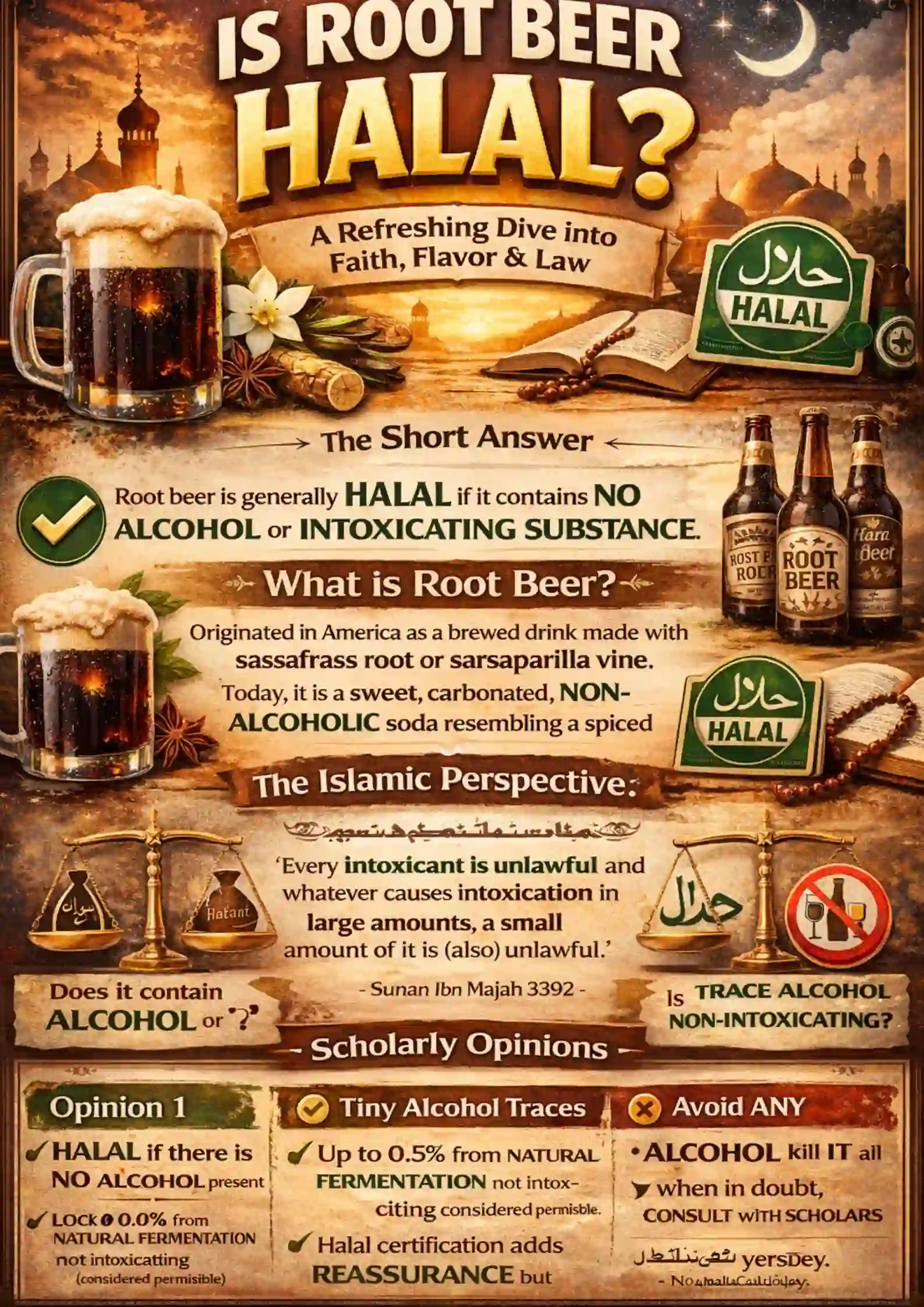
“Every intoxicant is unlawful and whatever causes intoxication in large amounts, a small amount of it is (also) unlawful.” — Sunan Ibn Majah 3392
Imagine this: a mug filled with frothy, dark-caramel fizz, crowned with a creamy head that looks almost like coffee… but tastes sweet, spicy, and mysteriously nostalgic. You take a sip, you smile — it’s root beer. But then a question breaks through your bliss: Is this fizzy drink halal? After all, its very name conjures another beverage entirely — alcoholic beer.
This question isn’t trivial for many Muslims. In an era when global foods and drinks mingle freely with our cultures, we must be confident — not confused — about what we consume. In this post, we’ll journey through history, ingredients, Islamic scholarly opinions, fatwas, and practical guidance — from start to finish — without ever losing your attention.
Let’s begin.
The Short Answer — Before We Go Deep
Yes — root beer is generally considered halal by Islamic scholars so long as it contains no alcohol or intoxicating substance. Most commercially available root beers today are non-alcoholic, so they are permissible for Muslims to drink. However, if a version contains significant alcohol — especially if it can intoxicate — it would be prohibited (haram).
What Is Root Beer Anyway?
Root beer originated in North America as a brewed drink made from the root bark of the sassafras tree (Sassafras albidum) or the sarsaparilla vine (Smilax ornata). Over centuries, it evolved into the sweet, carbonated soft drink we know today — resembling cola but with unique herbal spiced notes.
Despite the word “beer” in its name, modern root beer is typically non-alcoholic, caffeine-free, and sugary — much closer to soda than to alcoholic beer.
This brings us face-to-face with the heart of the matter: just because it’s called “beer” doesn’t mean it’s alcoholic. The name stuck historically, even though the alcoholic content has largely disappeared from commercial production.
Islamic Perspective । What Scholars Say
🔹 Principle । Alcohol & Intoxicants
Islam categorically prohibits alcohol and anything that intoxicates. This is based on the Quran and a rich body of hadith that forbids khamr (intoxicants) and anything that causes similar effects. The guiding principle is not the name of a product, but its content and effect.
That hadith we quoted above clarifies that anything that causes intoxication at large doses is itself prohibited even in small amounts.
So, when we apply this principle to root beer, two things matter:
- Does it contain alcohol or an intoxicant?
- If there is alcohol, is it trace/minimal and non-intoxicating?
Are Modern Root Beers Alcohol-Free?
Yes — most major commercial root beer brands produced today are non-alcoholic soft drinks. Their ingredient lists typically include:
- Carbonated water
- Sugar (or sweeteners)
- Natural & artificial flavors
- Caramel coloring
- Extracts like vanilla, wintergreen or sarsaparilla
There is no alcohol added in production.
However, it’s worth noting that some trace amounts of alcohol can naturally occur during fermentation-like processes or from certain flavor extracts. This is usually under 0.5% alcohol by volume — a tiny amount much lower than any intoxicating level.
Scholarly Opinions । The Nuances
Islamic scholars and halal authorities have discussed this issue, and while there’s broad agreement that non-intoxicating root beer is halāl, some nuances exist:
Opinion 1 — Halal If Alcohol-Free
Many scholars agree root beer is halal if there is no alcohol present. They base this on the clear prohibition of alcohol and intoxicants in Islamic law, and the simple fact that most root beers today do not contain alcohol or intoxicating properties.
This is the practical position for most Muslims: check the ingredients, and if there is no alcohol, it’s halal.
Opinion 2 — Minuscule Alcohol Traces Still Permissible
Some authorities point out that many beverages labeled “non-alcoholic” may contain tiny amounts (like up to 0.5%) of alcohol due to natural fermentation or flavoring processes. These trace amounts are not intoxicating, and some scholars consider them permissible because they do not cause intoxication.
This view aligns with established jurisprudence where negligible alcohol that cannot intoxicate is not treated as khamr.
Opinion 3 — Avoid Any Alcohol Content
A minority of scholars advise caution and recommend avoiding any drink that contains even minute traces of alcohol. Their stance is rooted in caution — better to avoid all substances with an alcohol presence, no matter how small.
While not the majority view, this opinion exists and is often cited for those who prefer maximum caution.
The Indonesian Ulama View — A Special Case
The Indonesian Council of Ulama (MUI) once ruled that root beer cannot be halal-certified because of its name, which contains the word “beer,” associated with intoxicants.
This is not a statement about the actual ingredients — it’s about marketing and certification criteria that consider cultural associations. It does not make root beer haram by virtue of its content.
What About Hard Root Beer?
There is such a thing as “hard root beer” — a version deliberately brewed to contain alcohol (often around 4% or more). This is clearly prohibited in Islam, being an alcoholic drink, just like regular beer.
So for clarity:
- Soft root beer (regular soda-type) → Usually halal
- Hard root beer (alcoholic) → Haram
Fatwa & Reference Points
While there isn’t a single, widely published global fatwa specifically labeled “Root Beer”, the rulings on drinks generally apply:
✔ Anything intoxicating or containing alcohol beyond trace amounts → haram
✔ Non-alcoholic drinks free of intoxicants → halal
Islam Q&A — a respected authority on Islamic legal questions — addresses beer and similar beverages, noting the clear prohibition of alcohol and permissibility of non-intoxicating drinks.
Does Root Beer Need a Halal Certificate?
No — not every halal product must carry certification. Halal certification is a means of assurance, but in principle, a product is halal if:
- Its ingredients are halal
- No haram process or contaminant is involved
For example, simple sugar is halal without a certificate. Similarly, root beer with halal ingredients and no alcohol is halal even if it does not carry a halal logo.
That said, halal certification from a recognized body adds peace of mind and reassurance for many consumers.
Practical Tips Before You Sip
✔ Always check the label for alcohol content.
✔ If a product says non-alcoholic, verify it lists 0.0% alcohol where possible.
✔ Be cautious with craft or old fashioned root beers — some traditional recipes may use fermentation.
✔ If in doubt, reach out to halal certification bodies or religious scholars.
What Muslims Around the World Think
Across Muslim communities (from Reddit discussions to everyday conversations), the general consensus reflects the technical ruling:
- Root beer without alcohol is considered halal.
- The name “root beer” doesn’t make it forbidden.
- Ingredient transparency is key.
- Halal certification is welcome but not mandatory.
Final Verdict — Sip Confidently or Skip If Unsure?
So where does that leave you?
👉 If the root beer you’re holding is non-alcoholic and free from intoxicants → you can drink it with confidence as halal.
👉 If it contains alcohol that could intoxicate → avoid it.
👉 If it has trace alcohol (less than intoxicating levels) — most scholars still allow it, though some caution against it.
This balanced approach respects both Islamic jurisprudence and modern food science. After all, halal rulings are meant to be clear, not confusing.
Why This Matters
We drink beverages not just to quench thirst — we partake in culture, identity, and community. For Muslims, ensuring what we consume aligns with divine guidance is an act of worship itself. Your choice to learn about something as seemingly simple as root beer reflects your sincerity in faith and mindfulness in practice.
And now… the next time someone hands you a frosty mug of root beer, you can smile knowingly — both refreshed and confident. 🥤✨