Imagine the smell of warm espresso curling through a crowded café, the soft hiss of steam, and a barista calling your name. For many of us the question that follows is practical and moral at once: “Can I drink this with a clear heart?” The answer isn’t a one-word verdict. It is a map: of local rules, ingredient lists, business choices and — sometimes — politics. Below I walk you through the issue step by step: what halal means in a coffeehouse context, what Starbucks publicly says, where Starbucks is certified, where it serves alcohol, how scholars and halal bodies have reacted, and how you — the reader — can decide in real time.
What “halal” means at a café
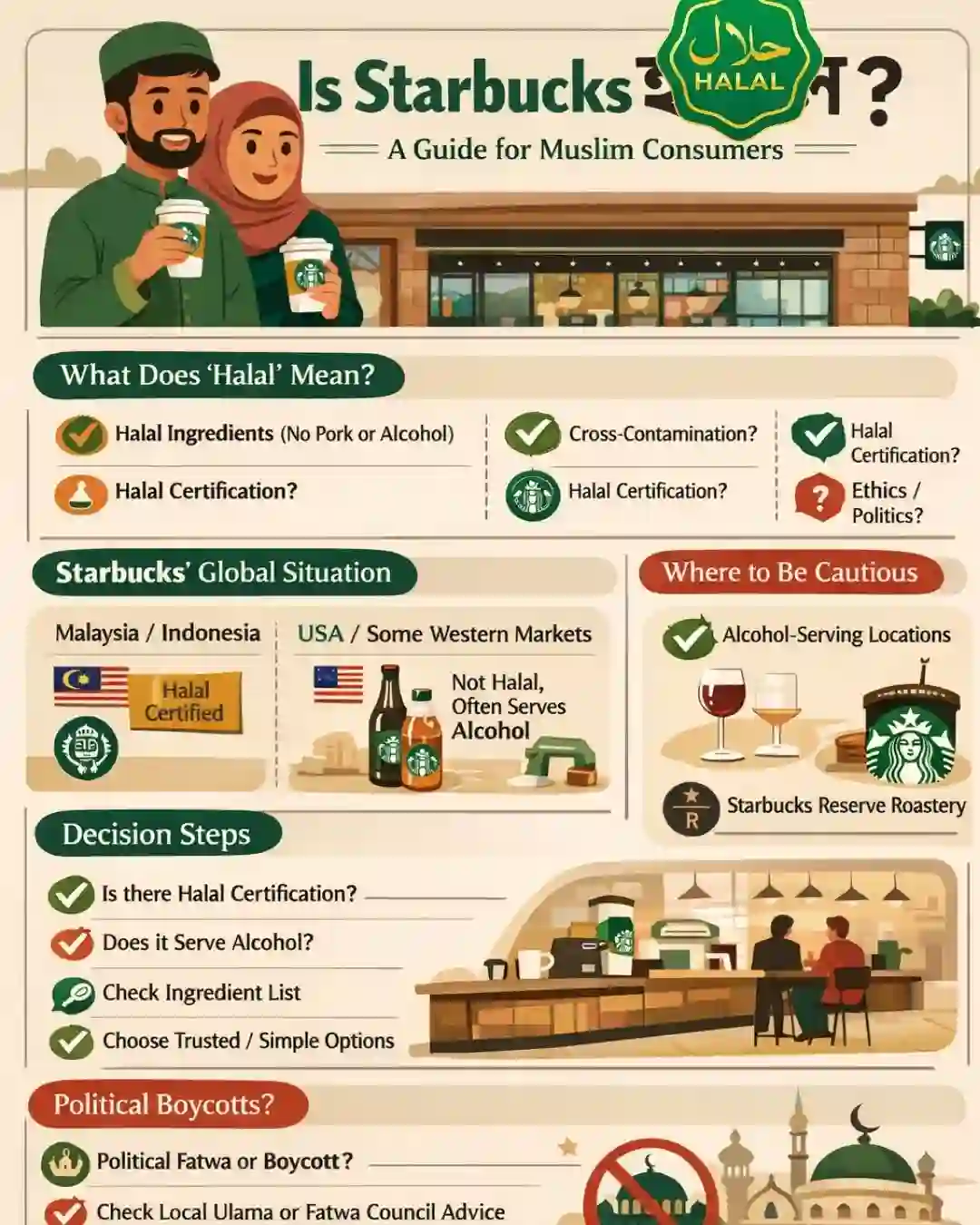
When Muslims ask whether a café or a product is halal they’re usually checking for a few things:
- Whether the ingredients are permissible (no pork, pork-derived gelatin, or intoxicants).
- Whether cross-contamination or shared equipment might introduce impermissible substances.
- Whether the establishment has local halal certification from an accepted authority (a practical shortcut many of us rely on).
- Occasionally — and more recently — whether a company’s actions make it the subject of religious rulings (e.g., boycott fatwas).
These four lenses are how jurists and halal agencies typically examine a food/drink question.
What Starbucks itself says
Starbucks is a vast global company with decentralized operations. The key fact to hold in mind: Starbucks’ halal status is not globally uniform — it depends on the country and sometimes on the outlet. In markets with large Muslim populations (for example Malaysia and Indonesia), Starbucks has pursued and obtained halal certification for its food and beverage items and publishes statements and policies reflecting that certification. Starbucks Malaysia explicitly states that its food and beverages are halal-certified and registered with the national halal authority. starbucks.com.my
At the same time, Starbucks’ corporate materials stress ingredient transparency and invite customers to consult ingredient and nutrition guides for specific products. That is useful for shoppers who wish to examine components like “natural flavors,” emulsifiers, or dressings. About Starbucks
Places where you should be careful
- Some Starbucks concepts or locations serve alcohol. Over recent years Starbucks experimented with “Evenings” and with Starbucks Reserve / Roastery locations that offer wine, beer, and cocktails. Those specific outlets (or licensed locations) are not appropriate for someone avoiding alcohol on principle. If a particular store sells alcohol on the premises, many scholars would recommend avoiding it or at least avoiding consuming any alcoholic products there. starbucksreserve.com
- Bottled or packaged Starbucks products sold in supermarkets (e.g., Frappuccino bottled drinks) often carry their own ingredient lists and may be kosher-certified, but certification varies by market and formulation — again, check the label. fairwaymarket.com
Certification: why it matters and how it varies by country
Most Muslims reasonably trust a recognized halal authority to do the ingredient and systems check for them. Where Starbucks has obtained such certification, the chain has typically submitted supplier lists, ingredient declarations and operational practices to national halal bodies (for example, JAKIM in Malaysia or LPPOM MUI in Indonesia). Those agencies inspect everything from ingredient sources to kitchen practices. That means that in certified countries, most core Starbucks menu items are covered by the halal certificate — though customers should still check the certificate’s scope (some items or promotions can be excluded). starbucks.com.my+1
Fact-checking organizations have debunked viral claims that Starbucks’ halal certificates were revoked in some markets; national halal agencies and Starbucks statements can usually settle those rumors. (Example: fact-checks concerning Malaysia clarified that Starbucks Malaysia remained certified, and Starbucks itself and JAKIM issued clarifying statements when false claims circulated.) Fact Check AFP
Scholars’ rulings & practical jurisprudence — two common positions
When Muslims ask “Is it permissible?” jurists respond in varying ways depending on facts. Two broad, commonly encountered positions:
- If the product is certified halal by a trusted local authority: many scholars treat the certification as a practical presumption of permissibility. Certification means the agency inspected ingredients and processes; so the product is allowed unless evidence to the contrary emerges. (This is the working rule in many Muslim-majority countries.) starbucks.com.my
- If the product is uncertified or sold at a location that serves alcohol / non-halal food: many scholars recommend caution. Some make nuanced distinctions: a non-intoxicating trace of alcohol in a flavoring (non-fermented, non-intoxicating, chemically denatured) may not render the product haram under certain juristic rules, while obvious use of alcohol (wine, beer, spirits) or pork products definitely does. Juristic rulings can differ by school and by the precise percentage/role of the forbidden substance. For workplace questions (e.g., is it permissible to work at a store that sells non-halal items?), reputable Islamic guidance centers urge care and context-sensitive rulings — SeekersGuidance, for example, explores those nuances (work vs. consumption) and advises consulting a qualified scholar when in doubt. SeekersGuidance
Politics and boycotts — a separate but influential thread
In late 2023 some national bodies (notably in Indonesia) issued fatwas and guidance encouraging boycott of companies perceived as supporting Israeli military actions; such rulings led to public debates and consumer boycotts that affected multi-national brands. Those kinds of rulings are political-religious responses and not strictly ingredient-based halal rulings; yet they affect halal discourse because some jurists frame the boycott as a religious duty when corporate actions are judged to materially support oppression. If you live in a country where such a fatwa exists, it may change the practical ruling for you. For example, Indonesia’s national ulema body issued guidance in late 2023 urging boycott of products and services that directly or indirectly support Israeli aggression — and that shaped popular practice and local rulings. If this is a key concern for you, check your own country’s ulama or fatwa council statements. The Jakarta Post+1
How to decide in practice — a simple decision checklist
If you want to make a halal-minded choice at Starbucks right now, follow this short checklist:
- Check local certification. Is the store or the country’s Starbucks operation halal-certified by a recognized authority (JAKIM, MUI, MUIS, LPPOM, etc.)? If yes, that is a strong sign of permissibility for the items covered. starbucks.com.my+1
- Ask about alcohol service. Does the outlet serve wine/beer/cocktails? If yes, avoid alcoholic offerings and consider whether cross-service affects the premises. starbucksreserve.com
- Check the ingredient list of the item you want. Starbucks posts ingredient and allergen info online; if you are unsure about “natural flavors,” ask staff to see supplier info or choose a simpler item (plain brewed coffee, espresso with milk from a certified source). About Starbucks
- Avoid bakery items unless certified. Pre-made pastries and certain gelatine-containing desserts can be problematic depending on local production; always check.
- If still uncertain, choose safer options — plain coffee, tea, or simple milk-based beverages — or patronize a clearly halal-certified café.
A few concrete examples
- Starbucks Malaysia: Starbucks Malaysia publicly states its outlets (in certain regions) are halal-certified and registered with JAKIM. That means most in-store beverages and foods are covered by JAKIM’s inspection. starbucks.com.my
- Starbucks Indonesia: Starbucks Indonesia has historically worked with MUI/LPPOM and operated under halal certification for many of its products; local developments (such as fatwas about boycotts) can overlay additional social considerations. jakartajive.com+1
- United States / some Western markets: Many Starbucks locations in the U.S. do not hold halal certification; some Starbucks Reserve or “Evenings” outlets serve alcohol. In those settings the default is to examine ingredients or choose simple items. starbucksreserve.com+1
FAQs
Q: “Can I have a latte at Starbucks in my city?”
A: If your local Starbucks is halal-certified, yes for certified items; if not, choose plain brewed coffee or check ingredient lists.
Q: “Do syrup ‘natural flavors’ contain alcohol?”
A: “Natural flavors” is a catch-all phrase. Some extracts historically use alcohol in their manufacture but the final product may have negligible or non-intoxicating levels; judgments differ among scholars. If this is decisive for you, ask the store for supplier details or pick an item without complex flavorings. About Starbucks
Q: “Is it sinful to work at Starbucks if it sells non-halal sandwiches?”
A: This is a sensitive fiqh question. Many scholars advise caution and context: the duties of the employee, the nature of the role, whether you directly promote or deal with haram goods, and the availability of halal employment alternatives all matter. SeekersGuidance and similar institutes offer nuanced guidance. SeekersGuidance
Q: “What about boycotts on political grounds?”
A: That depends on local fatwas and your personal conscience. In some countries MUI issued guidance in 2023 urging boycotts of companies seen as supporting Israel; individuals will weigh political/ethical causes alongside halal-ingestion rules. The Jakarta Post
Final thoughts
Food law in Islam is both practical and principled. We want clear rulings because lives are busy, but real-world companies operate across jurisdictions and shift menus, suppliers, and policies. The sound approach is threefold: rely on trusted local halal authorities where available; use ingredient transparency to make informed choices; and consult knowledgeable scholars if a novel or politicized situation arises.
If you live in a place where Starbucks carries an up-to-date halal certificate from a body you trust, you may enjoy your cup with confidence. If you are in a market where Starbucks isn’t certified, the prudent path is to choose simple items, check ingredient information, and avoid venues that openly serve alcohol — or support local halal cafés that meet your convictions.
Suggested short bibliography
(These are the most relevant public sources consulted while writing this post.)
- Starbucks Malaysia — “Our Halal Policy” (official statement on halal certification). starbucks.com.my
- Starbucks — corporate ingredient / nutrition transparency pages. About Starbucks
- Starbucks Reserve / Roastery menus and beverage programs showing wine, beer and cocktails are served in certain concepts. starbucksreserve.com
- Fact-checks and news clarifications about halal certificate rumors (e.g., AFP / national press clarifications). Fact Check AFP
- Coverage of Indonesian ulema council fatwa(s) and boycott guidance (Jakarta Post / Straits Times coverage). The Jakarta Post+1