Summary: “Joyride” is not one single thing. It can mean a candy brand, several restaurants, or simply the act of taking a carefree ride. This post explores each meaning, inspects ingredients and manufacturing claims, explains Islamic legal principles relevant to food that lack halal certification, and gives clear, practical guidance so you can decide with confidence.
The question we actually have to answer
When someone asks “Is Joyride halal?” the single most important clarification is that “Joyride” is ambiguous. There’s a contemporary candy brand called JOYRIDE (sweets and gummies), restaurants and cafés that use the name (e.g., Joyride Taco House, Joyride Pizza), and the everyday English noun “joyride” (an innocent drive or, illegally, a stolen car ride). Each case raises different halal concerns: ingredients and manufacturing for packaged food; sourcing, supply chain and kitchen practices for restaurants; and morality and legality for the act of a joyride. This post treats all three, giving both evidence and practical rulings.
The candy brand JOYRIDE : what the company actually says
If you mean the candy brand JOYRIDE (the popular low-sugar / “plant-based” gummy and strip products seen in major retailers), the company’s own Frequently Asked Questions page explicitly states that they are neither Kosher nor Halal and have no current plans to be certified. That is the primary empirical fact: there is no official halal certification from the manufacturer at time of writing. JOYRIDE
Their product pages and labels promote “plant-based” recipes and state that some items contain no gelatin or animal products, but they also disclose that their products are made in facilities that process milk, peanuts, soy and wheat — that opens the door to cross-contamination concerns for some Muslims. For specific products JOYRIDE advertises “no gelatin or other animal products” on some pages, but again the absence of a halal certificate and the shared-facility note are the decisive facts for many consumers. JOYRIDE+1
The restaurant Joyride : local variation matters
If you mean a restaurant named Joyride (for example Joyride Taco House in Arizona or regional pizza or diner concepts), the halal question can only be answered location by location. Some eateries may source halal-certified meat and advertise it; others may not. A restaurant’s name alone tells you nothing about halal compliance. Always check the specific branch’s menu, ask management about meat sourcing and cooking practices, and insist on written confirmation if you need it. You can find examples of Joyride restaurants online, but their halal status is not universal — it depends on each outlet. joyridetacohouse.com+1
Islamic legal principle : default permissibility — but with caveats
In Islamic jurisprudence there is a general legal maxim often invoked in these cases: “Everything is permissible unless proven otherwise” (الأصل في الأشياء الإباحة). Applied to food, this principle means an item is considered permissible provided there is no solid evidence of a prohibited ingredient (pork, blood, alcohol, meat not slaughtered properly, etc.). Many contemporary fatawa and Islamic guidance sources repeat this rule, while also cautioning about specific exceptions (notably meat and doubtful substances). Islam-QA+1
However — and this is crucial — that maxim does not give a blanket green light to eat anything produced in opaque supply chains. Modern processed foods may contain hidden alcohols, animal-derived emulsifiers, enzymes, glycerin, flavoring agents, or cross-contact with haram substances. For non-meat products, many halal certification bodies note that a food can be halal-suitable yet uncertified, but because of the complexity of supply chains certification provides reliable assurance. isahalal.com+1
Practical ingredient red flags to watch for in candies and processed food
When you inspect a Joyride candy label (or any processed good), look carefully for these red flags:
- Gelatin — often derived from pork or non-zabiha animal sources. Presence = haram (unless specifically from halal-slaughtered animals and certified).
- Glycerin / Glycerol — could be plant-based or animal-based. If animal-derived and from pork, it is haram.
- Emulsifiers & enzymes (e.g., lecithin, mono-/diglycerides, pepsin, pancreatin) — may be animal-derived.
- Alcohol or alcohol-derived flavoring agents — certain flavor extracts or solvent traces can be problematic.
- ‘Natural flavor’ without disclosure — ambiguous wording can hide animal-derived components.
- Shared facility / cross-contamination warnings — even if ingredients appear plant-based, manufacturing on lines that process haram items can be a concern for some.
If a label lists only recognizable plant-based components (fruit purée, sugar, pectin, citric acid, natural flavorings) and expressly states “no gelatin/animal products”, many scholars would allow it — but some Muslims will still prefer an official halal certificate for peace of mind. JOYRIDE’s marketing often points to “no gelatin” for some items, yet their lack of halal certification remains the practical obstacle. JOYRIDE+1
What scholars and halal authorities say about uncertified but seemingly halal products
Contemporary halal certification bodies and many scholars differentiate halal suitability (an item appears halal based on ingredients) from halal certification (third-party verification of sourcing, processing and segregation). The first may be acceptable to consumers who can trace and trust ingredient lists; the second is preferred if you require a chain of custody and auditing. Certification agencies argue that complex supply chains and hidden additives make certification the only reliable assurance for many processed foods. isahalal.com+1
Islamic legal responses vary: some jurists advise following the default permissibility rule if there is no evidence of haram ingredients; others urge caution where doubt exists (shrinking one’s domain of doubt in matters of worship and permissible consumption). Practically: if a company says “no animal products” but refuses to provide ingredient sourcing transparency, conservative guidance is to avoid if the consumer is uncomfortable. Islam-QA+1
The evidence on the ground about JOYRIDE
Public discussion around JOYRIDE shows mixed signals: retailers’ product Q&A entries, user forums and independent writeups sometimes say “no gelatin, vegan” while others caution “no halal certification” and flag the company’s own FAQ stating they currently have no halal certification. Consumer threads (Reddit, Target Q&A) display confusion — some buyers check the label and see plant-based claims, others point to lack of certification and potential cross-contamination. Independent halal-check sites have concluded that JOYRIDE products should not be assumed halal without verification. Reddit+2Reddit+2
The bottom line: empirical company statements + public retail notes = no halal certificate; some products may be plant-based, but certification and traceability are absent. JOYRIDE+1
How to decide — a practical decision tree for the Muslim consumer
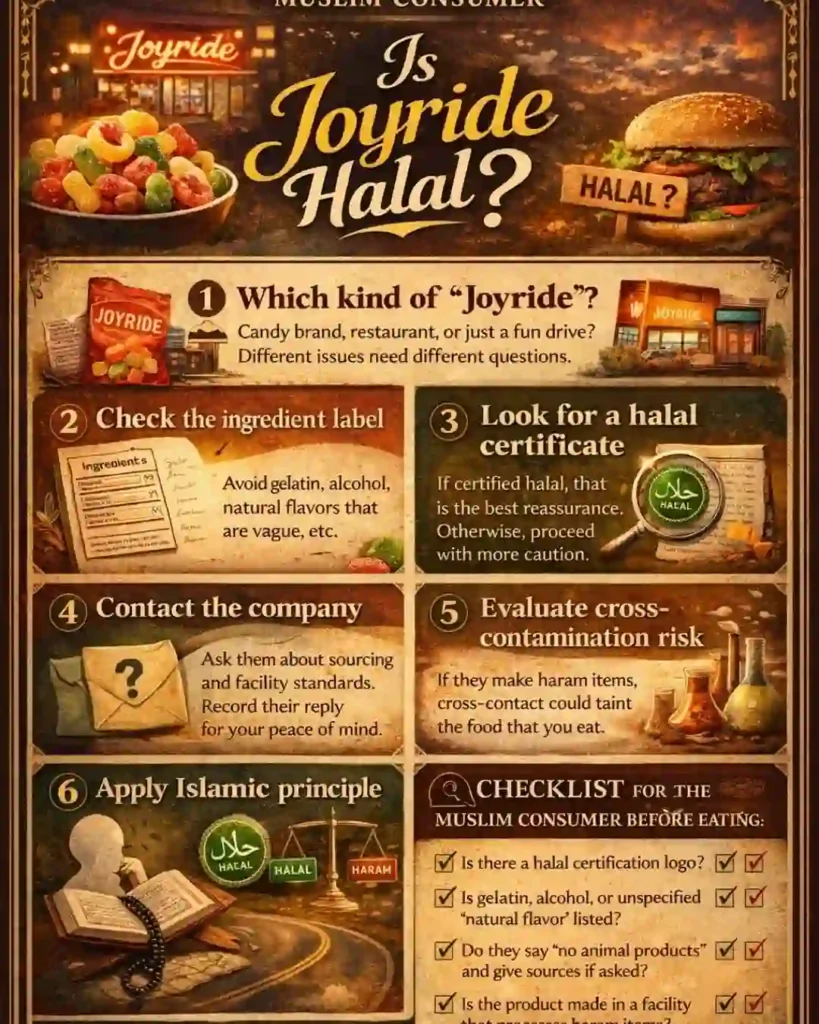
Here’s a clear, step-by-step method you can use when faced with a Joyride product or a similarly ambiguous item:
- Identify which “Joyride” you mean — candy brand, local restaurant, or something else.
- Read the ingredient label carefully. If you see pork, gelatin, alcohol, or undisclosed “natural flavors” that worry you, avoid.
- Search for halal certification on the package or the company’s website. If a certified halal logo exists for that product/batch, that is the strongest reassurance. JOYRIDE currently has no halal certification listed. JOYRIDE
- If ingredients look plant-based but there’s no certification, contact the manufacturer or retailer to ask about ingredient sourcing and whether glycerin/enzymes are plant-based. Record their reply.
- Consider cross-contamination risk — if the product is processed in a facility that handles haram items, decide based on your level of caution. JOYRIDE notes shared-facility processing on its FAQ. JOYRIDE
- Apply the fiqh maxim: if there is no proof of haram ingredients and the label appears clean, many scholars allow consumption; if doubt remains or the product is a repeat purchase for family/community use, prefer certified alternatives. Islam-QA
Alternatives and where to shop confidently
If you prefer certainty, choose confectionery with recognized halal certification from reputable agencies (e.g., local national halal bodies, IFANCA, JAKIM, MUI, or ISA depending on your country). Many major brands and regional producers now carry halal logos on packaging, and some stores (halal supermarkets) curate certified sweets and snacks. When in doubt, local halal butchers and certified bakeries are safer than uncertified mass-market products with ambiguous labeling. For restaurants, seek outlets that post halal certification or clearly state that meat is zabiha-slaughtered. Halal Food Council+1
Final verdict — nuanced, principled, practical
- If by “Joyride” you mean the JOYRIDE candy brand: not certified halal; some products may be plant-based and free of gelatin, but the company explicitly states it currently holds no halal certification and some production occurs in shared facilities, so cautious consumers will withhold automatic permissibility and should either seek clarification from the company or choose certified alternatives. JOYRIDE+1
- If you mean a restaurant named Joyride: answer depends on the individual outlet; ask and verify locally (menu, supplier receipts or a halal logo). joyridetacohouse.com
- If you mean the act of taking a joyride: an innocent ride is morally neutral and allowed; an illicit joyride (stealing a vehicle) is sinful and unlawful in Islam and secular law.
- The legal principle: everything is permissible until proven otherwise — but modern supply chains complicate that maxim. When uncertainty persists, many scholars advise erring on the side of caution for repeated or communal consumption, especially where meat or hidden animal derivatives may be involved. Islam-QA+1
Quick checklist
- Does the package show a halal certification logo? ✅ / ❌
- Is gelatin, alcohol, pork or undisclosed “natural flavor” listed? ✅ / ❌
- Does the manufacturer state “no animal products” and provide sourcing details on request? ✅ / ❌
- Is the product made in a facility that also processes haram items? ✅ / ❌
- If any answer is ❌ or “I don’t know,” either contact the brand or pick a certified alternative.
Epilogue — a gentle reminder for the heart and mind
Food is not just chemistry; it is also conscience. The legal maxims help us navigate modern shelves, yet they do not replace the inward discipline of a believer. If Joyride is a rare, personal treat and a label shows only plant-based ingredients, many will accept it; if you are feeding others, hosting guests, or prefer spiritual certainty, insist on certification or choose a clearly halal product. Either way, the path of prudence and inquiry honors both faith and intellect.
Sources and further reading
- JOYRIDE Sweets — FAQ (company statement on halal status). JOYRIDE
- JOYRIDE product pages (ingredient and “no gelatin” claims). JOYRIDE+1
- HalalInCorp analysis of JOYRIDE halal status (third-party writeup). Halal Incorp
- IslamQA — “Everything is permissible until proven prohibited” (fiqh principle). Islam-QA
- ISA Halal — distinction between halal suitability and halal certification (certification importance). isahalal.com