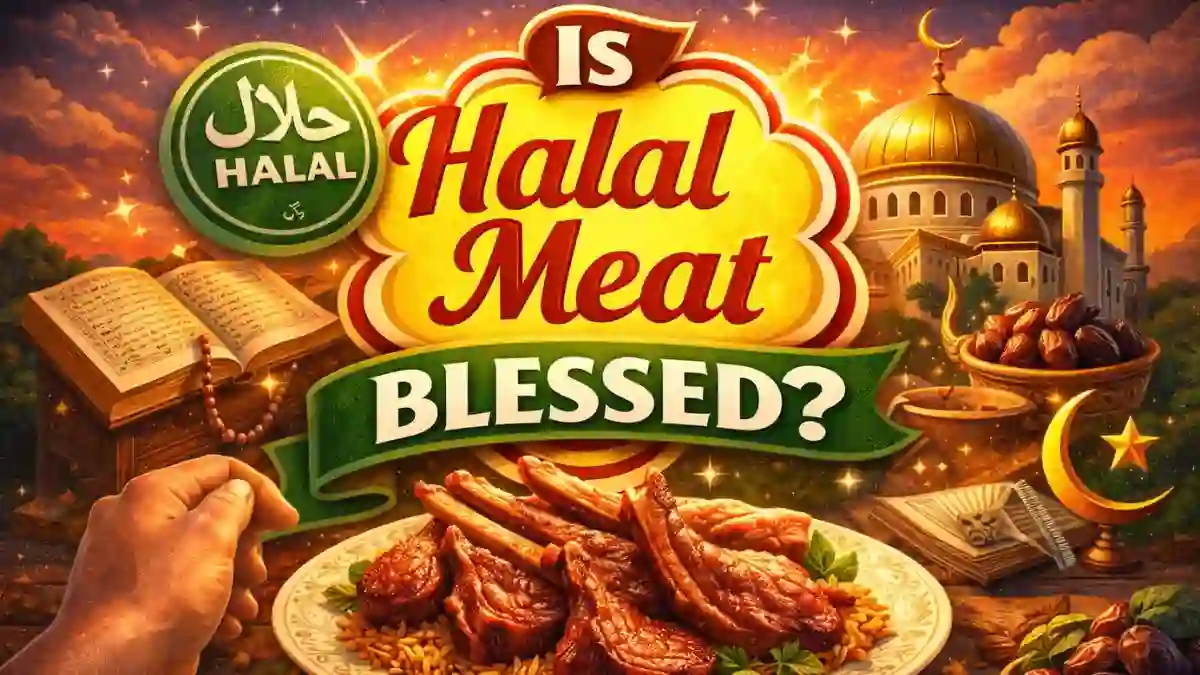
Short answer (for impatient readers): Yes — halal meat can be blessed (contain barakah) when it is lawfully earned, properly slaughtered with the name of Allah invoked, and consumed with gratitude and right intention. But halal by itself is a legal permission; blessing depends on context: intention, ethics, remembrance, and how the food is used in life. Sunnah.com+1
An opening scene: two identical plates, two different stories
Imagine two dinner tables. On both, a plate of lamb rests beside steaming rice. The food is identical in look and smell. At one table, the family says Bismillah, shares the meal, remembers the poor, and the conversation turns to humble gratitude. At the other, the meat was bought in secrecy, bought with questionable money, eaten alone, and the mind is restless. Something invisible separates these tables. That something — subtle, spiritual, and profoundly practical — is what Muslims call barakah: blessing, sustained goodness, and divine increase. The question we ask is whether halal meat carries that blessing by nature — or whether blessing is given, nurtured, and sometimes lost. The answer unfolds where scripture, prophetic teaching, and wisdom meet everyday life.
What does halal mean? What does “blessed” (barakah) mean?
Halal literally means “permitted” — a legal category in Islamic law. When we call meat halal we are usually affirming three things: the animal was of a permissible kind, it was slaughtered in a lawful manner (with the name of Allah invoked), and it was not obtained through forbidden means (the earnings and transaction are lawful).
Barakah means blessing — not necessarily more calories or better taste, but an unseen increase: a dish that feeds many, a small portion that suffices, peace of heart, and goodness that ripples beyond the plate. The Qur’an commands believers to eat what is halal and tayyib (lawful and wholesome/pure), linking legality with moral and spiritual quality. Quran.com+1
The scriptural spine: Quran and hadith that frame the question
Two Quranic directives anchor this discussion. First: “O mankind! Eat of what is on earth [that is] lawful and good (tayyib).” — a call not just to permission but to purity and wholesomeness. Second: “So eat of that upon which the name of Allah has been mentioned.” These verses make clear that mentioning Allah and seeking what is tayyib are integral to the food’s spiritual dimension. Quran.com+1
A resonant hadith explains the moral economy: “Verily Allah is Pure and accepts only that which is pure.” The Prophet ﷺ then described a disheveled man whose supplication might not be accepted because he is nourished by impure means — a sober reminder that our bodies and acts are not divorced from our devotional life. This hadith has been cited by scholars as a basis for linking lawful livelihood and lawful nourishment to spiritual acceptance. Sunnah.com
Finally, the Prophet ﷺ recommended social eating and remembrance: “Eat together and mention the name of Allah over it, for you will be blessed.” That practice locates barakah in community, etiquette, and the act of invoking the Divine. abuaminaelias.com
How halal becomes a channel for blessing — the practical anatomy
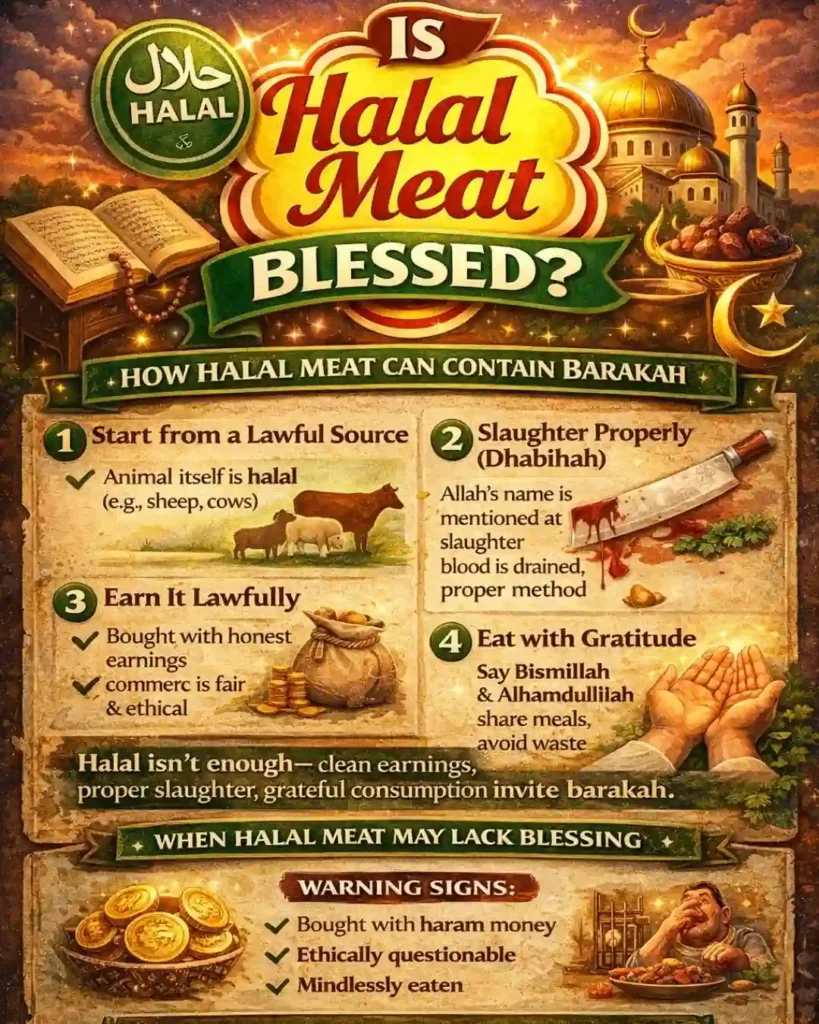
Halal meat becomes blessed when several elements align:
- Lawful source: The animal itself is permissible (e.g., sheep, goat, cow, camel) and not forbidden (e.g., swine, predators).
- Proper slaughter (dhabiha): The name of Allah is pronounced; the animal is treated mercifully; blood is drained — these transform killing into an act of obedience. The invocation is not mere formality: it is a spiritual marker that the act is performed under Divine ethical boundaries. quranx.com
- Lawful earnings and ethical commerce: If the meat is bought with dishonest money or procured through theft, its spiritual standing is compromised. Scholars emphasize that halal food should be earned through halal means; otherwise the blessing is diminished or lost. PMC
- Right intention and consumption manners: Eating to strengthen oneself for worship, to care for family, or to share with neighbors aligns consumption with the broader moral life. Saying Bismillah, sharing, avoiding waste, and eating with gratitude are all prophetic practices that invite barakah. abuaminaelias.com
When these weave together, halal meat becomes a vessel of blessing: a lawful provision that nourishes both body and spiritual capacity.
What the scholars say । classical voices and modern reflections
Classical scholars did not treat halal as a merely technical category divorced from ethics. Imam Al-Ghazali, in Ihyaʾ ʿUlum al-Din, stresses that lawful living and proper manners — including how one eats — shape the heart. The spiritual health of the heart is nourished by knowledge, remembrance, and ethical food. Ibn al-Qayyim and others repeatedly stress that what is lawful supports obedience while what is unlawful dulls conscience. ghazali.org+1
Contemporary scholars and halal researchers echo this: modern studies on halal and tayyib emphasize not only physical permissibility but also quality, ethics, and safety — all factors that relate to whether food brings real benefit and blessing. Institutional halal certification bodies stress that legitimacy includes supply-chain ethics, slaughter method audits, and avoidance of contamination — practical measures that protect the possibility of barakah. PMC+1
In short, the scholarly current is consistent: halal opens the door, but blessing is invited by conscience and practice.
When halal meat lacks blessing — three common pitfalls
Even if meat is technically halal, blessing may be compromised by:
- Unethical earnings: Money gained through fraud, interest, or exploitation strips spiritual benefit from what it buys.
- Cruelty or negligence in production: Industrial systems that mistreat animals, or slaughters performed without proper invocation or care, can satisfy form but undermine spirit. Scholars debate mechanical slaughter’s legitimacy in specific contexts, but most agree that respect and humane treatment matter. PMC
- Consumption without consciousness: Gluttony, waste, and consumption to boast diminish the soul’s receptivity. The Prophet’s etiquette — moderation, sharing, and saying Bismillah — were means to ensure food remained a blessing.
These pitfalls show that halal is necessary but not sufficient for barakah.
Barakah in practice — small habits that invite blessing
If you want halal food to be blessed, cultivate these modest practices:
- Begin with Bismillah and end with Alhamdulillah. Invocation frames the act.
- Prefer ethically sourced meat — ask about treatment and certification.
- Share meals; invite neighbors, family, or those in need. Communal eating is prophetic and multiplies blessing. abuaminaelias.com
- Avoid waste; serve modest portions and preserve leftovers for others.
- Make dua and be mindful: gratitude sharpens barakah.
These are not pious accessories — they are practical levers that tune ordinary eating into worshipful living.
Objections & nuances
“If halal meat is blessed, why do some who eat halal still suffer or sin?”
Blessing is not a talisman that guarantees worldly comfort. It is a spiritual quality that increases benefit and may be realized in subtle ways: ease in the heart, acceptance of supplication, or a small portion that suffices. Trials still occur; barakah shapes how provision is experienced and used.
“What about vegetarian or vegan food?”
Halal is a legal category; vegetarian food can certainly be halal and blessed. The emphasis on halal meat arises because taking life demands ethical responsibility — a heavier moral threshold — but blessing is primarily about intention and obedience, not species. quranx.com
“Does modern industrial halal count?”
Many modern certifiers work to ensure slaughter standards, traceability, and humane treatment. However, consumers should be discerning: certification quality varies, and the ethical integrity of supply chains matters to barakah. PMC
A short, lived parable
An old Sufi master placed the same stew before two students. One ate in silence, offered a brief prayer, and left to feed a homeless man with the remainder. The other ate in haste, mocking the piety of the first. Weeks later, both returned; the first had a calm mind and steady work, the second was restless, anxious, and restless at night. The meat did not change — the hearts did. The master smiled and said, “The one who eats with mercy carries mercy in his bones.” This is not magical thinking: it is the Qur’anic ethic in living form — where lawful means and right action shape inner states.
Conclusion | a measured and hopeful verdict
Halal meat is the necessary ground for blessing: it clears the legal and ritual obstacles, acknowledges Divine ownership of life, and allows consumption without guilt. But blessing does not arrive as an automatic feature stamped on a label. It depends on how the meat was obtained, how it was slaughtered, how it is consumed, and why we eat it.
To secure barakah: seek halal and tayyib; insist on ethical supply chains; eat with gratitude; share with others; and let your meals be prayers in practice. In this way, what you eat will feed not only your body but the finer life of your heart.
Further reading & authoritative references
- Qur’an — guidance on lawful and wholesome food: Surah Al-Baqarah 2:168 and Surah Al-An‘am 6:118 (tafsir and translation). Quran.com+1
- Hadith — Allah is Pure and accepts only that which is pure (Sahih Muslim; the man whose food was impure). Sunnah.com
- Prophetic etiquette on barakah in eating together and mentioning Allah (Sunan Abī Dāwud). abuaminaelias.com
- Modern scholarly discussion of halal/tayyib and contemporary food systems (peer-reviewed overview). PMC
- Imam Al-Ghazali, Iḥyāʾ ʿUlūm al-Dīn — reflections on food, the heart, and spiritual nourishment. ghazali.org